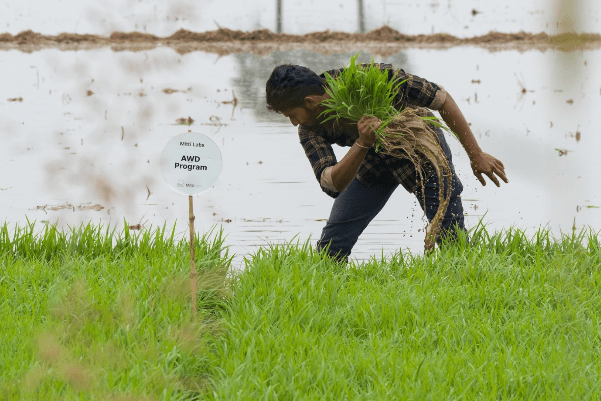
Farmers have used Alternate Wetting and Drying (AWD) for years to reduce water use in rice cultivation. Now, Google has agreed to purchase 1 million carbon credits from Indian climate-tech company Mitti Labs by 2030, covering rice farms across Karnataka, Andhra Pradesh and Telangana and aiming to reach more than 70,000 smallholder farmers across roughly 100,000 hectares at peak delivery.
Mitti describes the agreement as an offtake arrangement, meaning payments are made on delivery of verified credits rather than upfront financing. The agreement is between Google and Mitti, while farmers participate in the underlying project. The credits will be delivered through 2030, rather than representing 1 million already-issued credits. So, what is Google actually buying?
A carbon credit is supposed to represent a quantified reduction in greenhouse gas emissions, measured in tonnes of carbon dioxide equivalent. Here, the focus is methane from rice cultivation. Under Isometric's methodology, one tonne of methane is treated as having the same 100-year warming impact as 27.9 tonnes of CO₂, even though the methane doesn't physically become carbon dioxide. The conversion is simply an accounting tool that allows different greenhouse gases to be compared using a common unit.
Mitti's project estimates its reduction by comparing methane emissions under the project against a baseline representing what would have happened without it, while also accounting for other relevant emissions like nitrous oxide. That distinction matters, because a carbon credit isn't simply evidence that AWD took place. It's meant to represent a reduction that is additional to what would otherwise have occurred.
Why are rice farms entering the carbon market?
AWD is not a new way of growing rice. Farmers have used it for years to cut water use and, when implemented appropriately, limit impacts on yields. What's changing is how the practice is being measured, quantified and brought into the carbon market.
Continuously flooded rice fields create oxygen-poor conditions that let methane-producing microorganisms thrive. AWD interrupts this by periodically draining and reflooding fields, cutting both methane and irrigation demand at the same time.
A 2017 meta-analysis of 56 studies found mild AWD reduced water use by 23.4% with little yield impact, while severe AWD cut yields by 22.6%. The benefit is real, but implementation dependent.
Mitti's monitoring combines satellite radar with on-the-ground checks, while Isometric's protocol allows remote sensing, field records and farmer attestation as evidence of baseline conditions.
Measuring methane under AWD, comparing it with a baseline and converting the difference into CO₂e is what turns a reduction into a credit.
But measurement has a limit. Satellite imagery can show a field was dried and reflooded on schedule, but it can't show why the farmer did it. And that "why" is exactly what determines whether a reduction can be attributed to the project, rather than to something that would have happened anyway.
What makes a rice carbon credit legitimate?
One of the key requirements is additionality. A carbon project has to establish what farmers would have done without the project, even though that alternative scenario can never be directly observed. That is unusually difficult for Mitti's project because AWD is already being promoted through several channels that have nothing to do with Google's deal.
The ClimaAdapt programme implemented AWD in the Krishna basin of Andhra Pradesh and Telangana between 2012 and 2016, with its findings feeding into state-level adaptation policy published in 2017. Dr. Reddy's Foundation has also promoted AWD across the same two states since 2020. Separately, a different carbon project run by Sow & Reap is already paying farmers directly: its VARRI project has reached more than 35,000 farmers across nearly 100,000 acres in eight Telangana districts, with emissions reductions already verified.
None of this proves Mitti's project lacks additionality. It does, however, show that AWD was already being promoted before Mitti's project, through routes that have nothing to do with Google's purchase. That makes the counterfactual more difficult to establish.
This is where Isometric's methodology becomes important. Its protocol requires additionality to be assessed at the project level, including by looking at how common AWD already is across the relevant region. Adoption through other programmes, including other carbon projects, can therefore form part of the evidence used to establish whether AWD is already common practice. The 20% threshold does not simply remove competing carbon projects from the comparison.
At the same time, there are barriers to AWD adoption. A 2020 study of Odisha farmers found lack of awareness, weed-management costs and poor extension support among the main barriers to adoption. The evidence therefore points in both directions: AWD has established routes for adoption, but there are also barriers that could prevent farmers from adopting it without additional support.
This is not a theoretical risk. RMI's 2025 analysis found that, in 2024, Verra invalidated 37 Chinese rice-methane projects representing around 4.5 million credits over additionality and baseline concerns. Those projects used an older methodology, so the comparison is not direct, but RMI still identifies additionality, baseline setting and monitoring as continuing risks for rice credits more broadly.
There is also a counterweight worth noting. Mitti underwent a Pre-Issuance assessment from Sylvera, a carbon-ratings agency whose framework evaluates additionality, permanence and measurability. That provides some external scrutiny, but it is not the final word. The formal validation and verification process that determines whether credits can be issued is still ongoing.
Why does this matter for Google?
The issue matters beyond this one project, because Google's emissions have continued to rise as its AI and data-centre operations expand. Its 2026 Environmental Report, covering 2025, reports ambition-based emissions of roughly 14.5 million tonnes of CO₂e, an 18% increase on the previous year and 81% above its 2019 baseline. Much of the increase came from its supply chain, including the infrastructure needed to support its growing operations. Google says it is continuing to invest in clean energy and efficiency measures but has also acknowledged the challenge that rapid AI growth creates for its 2030 net-zero goal.
For Google, the question is therefore not simply whether AWD reduces methane. It is whether the credits it purchases represent climate benefits that can be credibly attributed to the project.
Mitti's project is currently listed as under validation on the Isometric registry, with initial credit issuance expected in 2026. Its additionality assessment is still part of that process. The public record establishes the scale of Google's commitment and describes the monitoring approach but does not provide enough project-specific evidence to independently reconstruct the counterfactual.
Better monitoring can show what happened across thousands of farms, but it cannot by itself establish what would have happened without the project.
AWD can reduce methane. The harder part is establishing whether the carbon credit represents a reduction that would not otherwise have happened.
References
- Google (2026), '5 new ways Google is advancing sustainable innovation in India', 10 September 2026.
- Singh, J. (2026), 'Google signs its biggest rice-methane carbon credit deal with Indian startup Mitti Labs', TechCrunch, 10 September 2026.
- Inc42 (2026), 'Mitti Labs Enters Deal With Google For 1 Mn Carbon Credits', 11 September 2026.
- Isometric (2026), 'Rice Methane Reduction v1.0'.
- Carrijo, D.R., Lundy, M.E. and Linquist, B.A. (2017), 'Rice yields and water use under alternate wetting and drying irrigation: A meta-analysis', Field Crops Research, 203, pp. 173–180.
- Verra (2024), 'Verra Rejects Projects Using Inactivated UNFCCC CDM Rice Cultivation Methodology', 28 August 2024.
- Rocky Mountain Institute (2025), 'Technical Explainer: Carbon Credits for Improved Rice Cultivation', 30 July 2025.
- Nagothu, U.S., Krishna Reddy, K., Yella Reddy, K., Geethalakshmi, V. and Anabel, N.J. (2017), 'Climate Change Adaptation in Agriculture and Water Sectors: Policy Inputs for Telangana State, India', ClimaAdapt Policy Manual, April 2017.
- Dr. Reddy's Foundation (2022), 'Climate-Smart Rice Cultivation Systems’, Action for Climate and Environment (ACE) Programme case study, AVPN, 26 September 2022.
- Dutta, B.P., Mishra, A. and Kanungo, A.P. (2020), 'Constraints Perceived by the Farmers for Adoption of Alternate Wetting and Drying (AWD) Technology in Puri District of Odisha, India', International Journal of Current Microbiology and Applied Sciences, 9(4), pp. 181–185.
- United News of India (2026), 'Farmers receive first payments under Telangana paddy carbon programme', 1 September 2026.
- Sylvera (2025), 'How Mitti Labs validated an emerging project type and unlocked demand', 26 September 2025.