Keep some perspective on the numbers. Brent near $76 is a long way below April's $126 peak when the Strait was first disrupted, but well above the sub-$70 it touched in late June when a fragile ceasefire coaxed prices back towards pre-war levels. The market keeps trying to relax; something keeps stopping it. This week it was fresh US strikes on Iran and the revocation of the waiver that had let Iranian crude flow, with the tanker traffic through the Strait of Hormuz running well below normal even as Gulf producers lifted output to compensate. The strait of Hormuz carries roughly a fifth of the world's traded oil through a single pressure point. One waterway, and the whole system flinches.
For the integrated majors, that flinch is a revenue event. The sector heads into earnings season expecting profit growth of about 122% against the same quarter last year, close to double the 63% forecast for technology, with Shell and ExxonMobil both signalling earnings beats. The logic is old and reliable: chaos that raises a household's heating bill is, for the majors' shareholders, simply a good quarter. That is the first point to note, because it means a powerful, well-capitalised set of interests, firms are structurally long disorder.
The incentive problem, stated carefully
The market has also had to price a stranger variable this year: political messaging. Inside a single fortnight the US president called the ceasefire over and warned that oil could climb, then told reporters he expected prices to fall on an emerging glut. Each remark moved the benchmark. We make no claim of deliberate management, and market manipulation is a specific legal charge this analysis does not bring. The point is narrower and more useful for a risk desk. A president facing midterm elections in November has a clear interest in low pump prices; the energy sector books its best quarter in years on the spikes; and Tehran's leverage rises with every barrel it keeps off the water. Berenberg's Holger Schmieding made the incentives plainly in a note this week, contrasting a US preference for cheap oil with Iran's appetite for sanctions revenue. Three actors, three incentive structures, one market. Incentives, not intentions, are usually the better explanation, and they describe a market that stays jumpy while those interests remain unaligned.
The Blockade-Exposure Index
This is Howden Research's original contribution, and it is derived from a single fact. Electricity does not depend on where it was generated. It can be made by gas, coal, nuclear, solar or wind, and once on the grid nothing downstream knows the difference. Oil has no such flexibility: it has to move, by tanker, through checkpoints, past whoever controls the water that week. The Blockade-Exposure Index (BEI) scores how vulnerable an energy carrier is to physical supply interruption, on four measures where a higher score means more exposed.
Routing exposure captures dependence on contestable chokepoints. Non-substitutability captures how locked the end use is to one fuel. Storage buffer captures how little inventory sits between supply and demand. Pass-through captures how fast a supply shock reaches the consumer's bill. Weighted 0.35, 0.30, 0.15 and 0.20, they produce a single figure out of one hundred.
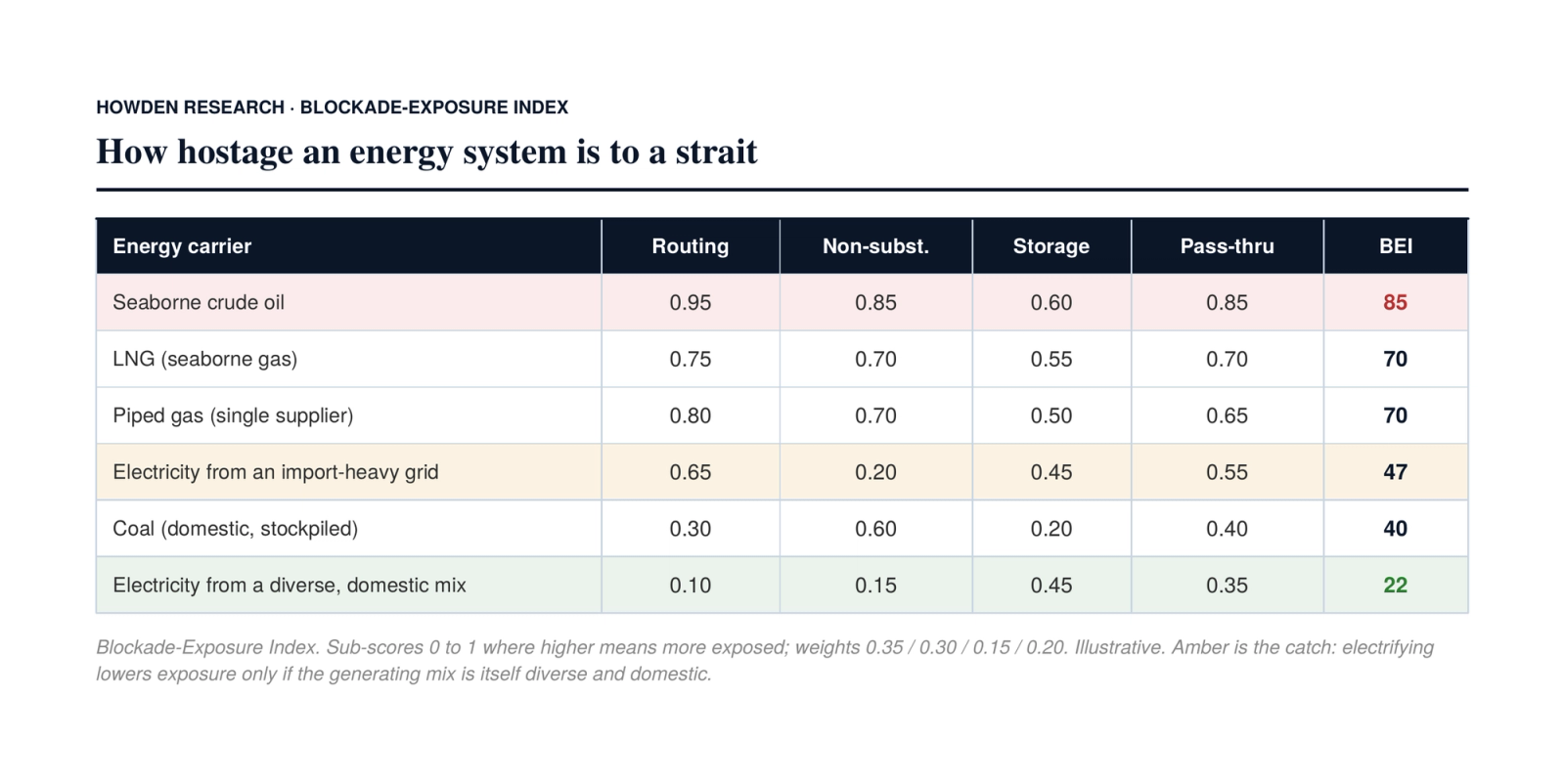
The spread is the argument. Seaborne crude tops the table because it combines chokepoint routing with an end use that cannot switch fuels overnight. A diverse domestic power system sits at the bottom, because an electron is fungible at the point of use and nobody can blockade the wind. China worked this out years ago and electrified fast, which is a large part of why oil shock now barely dents its growth. The honest caveat is the amber row: a grid still leaning on imported gas carries much of the exposure it claims to have escaped. Electrification is the hedge, but only if the generation behind it is genuinely diversified. Read as a lens on economies and portfolios rather than fuels, the BEI turns the vague phrase energy security into something scorable, and it prices the premium a country pays for remaining hostage to a strait.
The disorder dividend
Put the earnings and the exposure together and a transfer appears. When a chokepoint tightens, the cost flows to whoever is the highest on the Blockade-Exposure Index — the motorist, the household on a gas-heavy tariff, the import-dependent economy — and the profit flows to whoever is short stability / long volatility, the integrated major booking a record quarter. Call it the disorder dividend: the earnings a portfolio collects for being long instability. It is not confined to oil. Parts of the defence complex and some commodity traders carry the same negative exposure to calm. The uncomfortable implication for a risk desk is that a chunk of the fossil sector's return is, in aggregate, a payment from the physically and fiscally exposed to the disorder-exposed, and that payment quietly finances the delay of the very transition that would shrink both risks at once.
The loop that feeds itself
The two risks are usually modelled apart, geopolitical and transition risk on one desk, physical climate risk on another. This year they arrived together. As Brent climbed, Britain entered its third heatwave of the summer so far, with the Met Office logging a national record for the number of extreme heat days in a single year. Across the Channel it was worse: preliminary estimates put the June European heat toll in the thousands, and the World Weather Attribution judged the event effectively impossible without climate change, ruling out El Niño as the cause. Europe is warming at about twice the global rate. Now here is the loop. Heat drives cooling, cooling drives power-demand, and where that power still leans off fossil generation, every geopolitical flare-up that lifts fossil profitability hardens the incentive to keep drilling. The system burns more to survive the heat that burning produced. For an insurer, that is not a metaphor; it is a correlated-risk problem, two shocks that were assumed independent turning out to compound on the same summer and, often, the same regions.
Distribution: the UK exposure
Neither shock is shared evenly across the country. The UK is usually exposed to the oil leg. It imports the majority of the crude and refined product that it burns, its motorists face some of the highest fuel-duty-inclusive pump prices in Europe, and its power system still leans on gas at the margin, so a Brent spike passes through to petrol, diesel and the wholesale electricity price within weeks. On a Blockade-Exposure basis the UK scores high: import-dependent, gas-heavy, thin on strategic storage, with a fast pass-through to the consumer. The regressive part is that fuel and heating take a larger share of income the lower down the distribution you look, so the same crude move that reads as a headline for a fund is a squeeze on discretionary spending by lower-income households and a margin problem for haulage, agriculture and energy-intensive industry.
The heat leg lands unevenly too. Britain's housing stock is among the least heat resilient in Europe, built to retain warmth rather than shed it, and air conditioning is rare in homes, so a record run of extreme-heat days shows up as excess mortality among the elderly and the unwell and as lost productivity rather than as cooling bills. Dense urban areas run hotter as heat islands, and the households least able to adapt are the most exposed. The two legs compound: the oil premium raises the cost of the very energy needed to keep cool, so a hot, tense summer taxes the same UK households twice, once at the pump and once in the heat. That is the macro story arriving in specific budgets rather than staying on a screen.
Implications and outlook
For investors and insurers, the BEI is a portfolio and sovereign lens as much as fuel rankings. A book heavy in high-BEI exposures is structurally long disorder whether or not it means to be, and hedging that is not only a matter of commodity positions but of weighting towards the electrification and grid assets that lower an economy's exposure over time. The near-term read is unglamorous: expect more of the same, volatility that serves the incumbents, a floor under prices whenever the Gulf experiences renewed disruption, and a fossil sector booking strong profits while the temperature records fall. The way out is the same as the way out of the climate spiral, which is to stop depending on the fuel that makes both possible. Every barrel that a solar panel or a heat pump displaces is one that no strait can hold hostage. For integrated oil majors, geopolitical disruption has translated into outsized earnings. For households, it has translated into higher energy costs during one of Europe's hottest summers on record. The same dependence on fossil fuels is amplifying both outcomes simultaneously. The sooner the two are read as one, the sooner the incentives that keep running start to change.