
Britain’s gilt market is often treated as a story about the state, but a more interesting effect of these high gilt yields is what they do beyond Whitehall. High yields are improving pension funding and annuity economics but are also keeping long-term borrowing expensive for households and raising the Treasury’s financing bill. In light of this, high gilt yields are not just a market signal, but also a redistribution mechanism.
The backdrop of the gilt market remains unusually stark, as shown by recent gilt yields. In late June, the UK 10-year gilt yield was around 4.7% to 4.8%, while the 30-year gilt was around 5.4%. Bank Rate, the Bank of England’s main policy interest rate, remains lower at 3.75%. That gap exists because long‑dated gilts reflect both markets’ expectations for the path of Bank Rate over many years and an extra ‘term premium’ for locking money up for longer, so they can stay higher than today’s policy rate even once it has started to fall. This gap matters because long gilt yields, not just Bank Rate, shapes the price of long-term money across the economy.
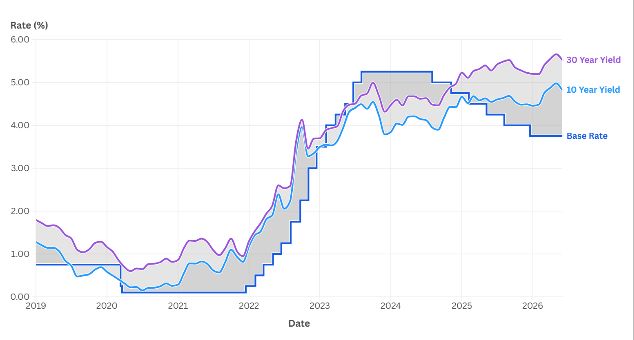
Long-term gilt yields are still high because they are being driven by more than Bank Rate alone. In January, the Bank of England said that higher term premiums were the main driver of higher UK long-term rates in 2025. In other words, investors still want a relatively high return to lend to the Government for long periods. This is significant because those long rates feed directly into pensions, annuities and fixed-rate borrowing.
Pensions and annuities
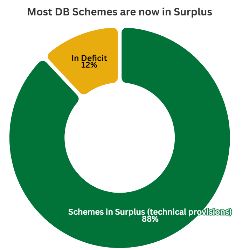
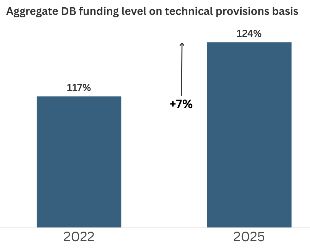
Higher gilt yields raise the discount rates used to value future pension promises, which lowers the present value of liabilities and improves funding levels, meaning that pensions are among the clearest beneficiaries of the above. The Pensions Regulator said in its 2026 Annual Funding Statement analysis that long-dated conventional and index-linked gilt yields rose steadily over the three years up to 31 December 2025, with nominal yields moving from about 4.0% to about 5.0% and real yields from about 0.5% to about 2.0%. It also estimated that the aggregate funding level for private sector defined benefit schemes reached 124% on a technical provisions basis by the end of 2025, up from 117% three years earlier, while 88% of schemes were in surplus.
This explains why many schemes have shifted from deficit repair to endgame planning. The same analysis estimates that £135 billion of pension liabilities were insured through annuity purchases, buy-ins or buy-outs over the three years to December 2025. Higher long yields make these transactions easier to price and, in broad terms, more affordable.
The same logic also helps individuals that are buying annuities. When insurers can invest premiums at higher long-term yields, they can generally offer stronger retirement income. For savers approaching retirement, that makes the gilt market more relevant than it first appears.
Mortgages and the state
The main losers of the gilt market are borrowers. Fixed mortgage pricing is linked to longer-term market rates, and the Bank of England’s yield-curve framework shows why those rates matter alongside Bank Rate. Fixed‑rate mortgage pricing follows swap rates and gilt yields because lenders fund and hedge those loans in wholesale markets priced off SONIA swaps and the gilt curve, so the cost of offering a two‑ or five‑year fix depends more on expected future interest rates than on today’s Bank Rate alone. So even if the policy rate is steady, elevated long gilt yields can keep fixed mortgage rates and remortgaging costs under pressure. On a £250,000 repayment mortgage over 25 years, a 1 percentage point rise in the rate adds roughly £148 a month. That is enough to hit affordability, especially for first-time buyers and households rolling off older fixed deals.
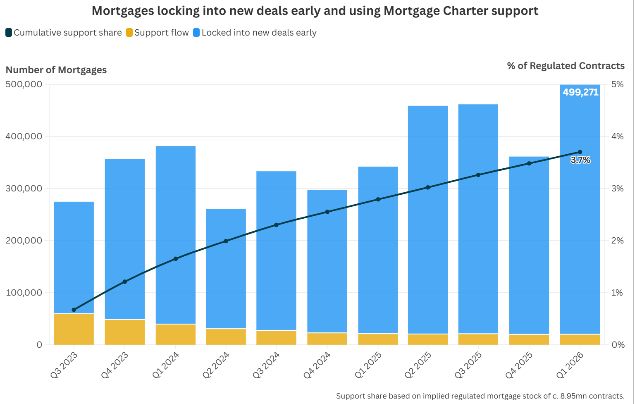
Recent mortgage‑charter data show how widespread that refinancing pressure has become: in the first quarter of 2026 around 500,000 mortgages locked into a new deal up to six months before maturity, while roughly 331,000 mortgages – about 3.7 per cent of regulated contracts – have already used temporary payment reductions or term extensions since mid‑2023.
The Treasury faces the same problem on a larger scale. The effect of higher yields is gradual because gilts are fixed-rate instruments, but over time they raise the cost of new borrowing and refinancing. The Debt Management Report for 2026-27 set the net financing requirement at £257.1 billion, to be financed mainly through £252.1 billion of gilt sales. Net debt interest now absorbs around 8–10 per cent of total government spending – roughly twice its share in the late 2010s – so higher gilt yields translate directly into a larger slice of the budget being used to service past borrowing rather than current services or investment. High gilt yields are therefore helping one part of Britain’s financial system while tightening conditions elsewhere.
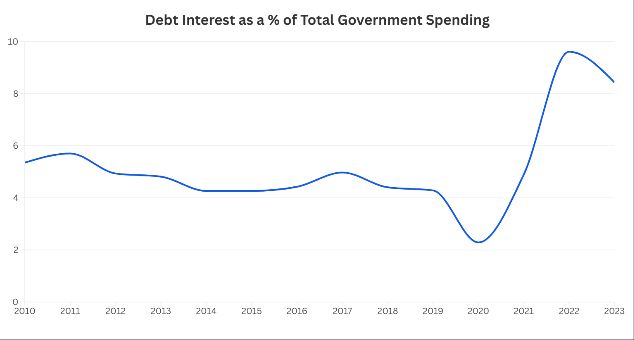
Overall, the result of this is that there is a clear split of winners and losers – higher gilt yields are not simply bad news for everyone. They improve pension funding and support annuity income, but they also keep mortgage borrowing costly and add to the state’s financing burden. Hence it is important to read today’s gilt market not as a narrow bond story, but as a transfer from public and household borrowers to long-duration savers.