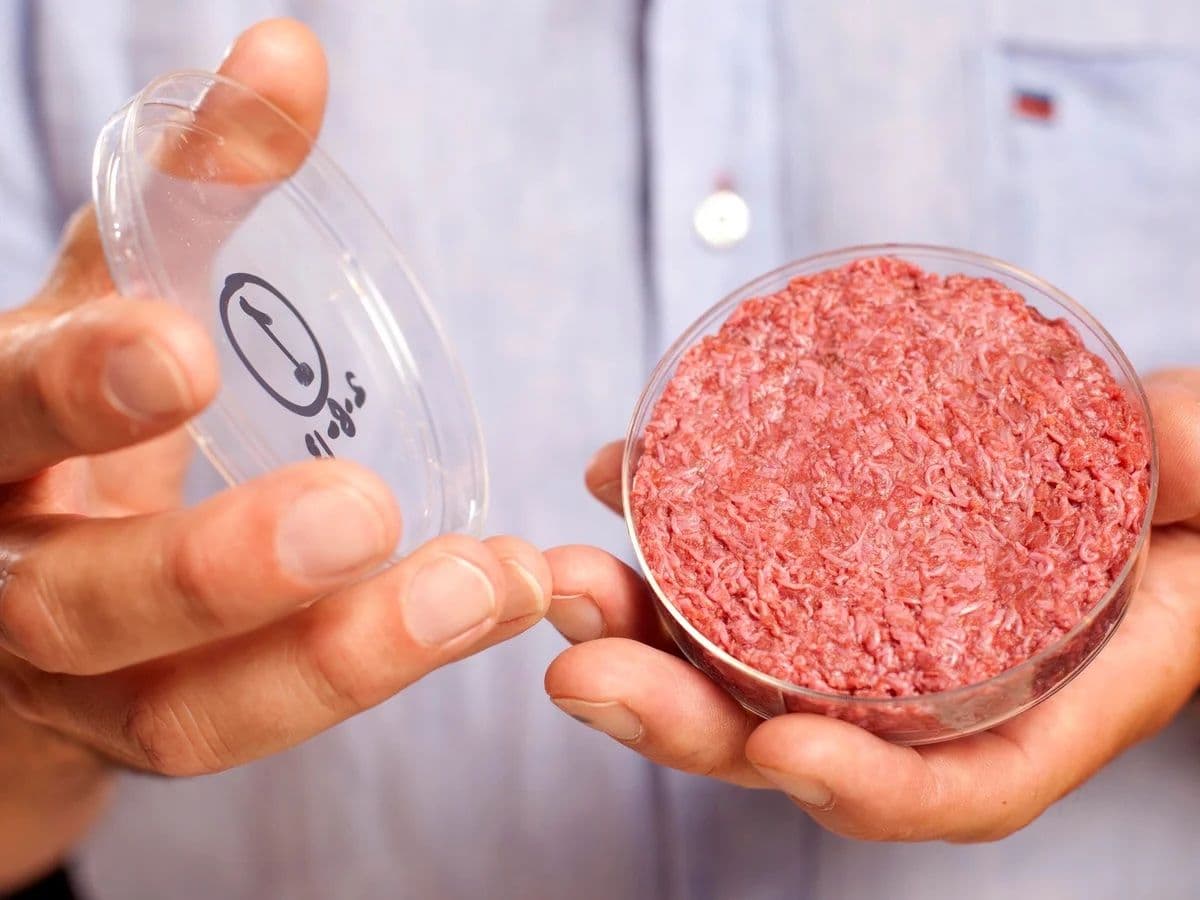
The cost of producing cultivated meat has fallen since the start of the industry. From the initial 2013 lab proof-of-concept burger patty (which cost an estimated £250,000 to produce) to a modelled projection of approximately £10.93 per kilogram in highly optimized, advanced trials. However, these figures are not directly comparable. The initial 2013 milestone represented a bespoke, small-scale laboratory experiment using medical-grade resources, whereas the £10.93/kg benchmark is derived from techno-economic models projecting idealized, scaled-up facility conditions. It does not reflect the actual commercial production costs that operating companies are achieving on factory floors today.
It is important to distinguish between the factory's raw production cost and the final retail price paid by consumers. Even if a facility achieves a modelled production cost of £10.93/kg for cultivated meat, the shelf price must incorporate post-harvest processing, distribution, marketing, retailer margins, etc. Therefore, price parity at production level does not mean retail price parity.
The problem facing the industry today is not whether cultivated meat can be successfully produced at a low cost within a controlled laboratory or optimized pilot-scale environment. Instead, the challenge lies in whether low production cost can survive the transition to massive, capital-intensive commercial-scale production.
Techno-economic analyses (TEAs) generally attribute these projected cost reductions to two main factors, but these factors are highly interdependent rather than isolated, linear cost buckets:
1. Optimisation of cell culture media (55% to 95% of Scaled Variable Costs)
Cells are grown in a nutrient-rich cell culture media that provides the foundational building blocks required for growth. At commercial volumes, media fluids remain the single largest bottleneck, commanding up to 95% of ongoing operating expenses (CE Delft, 2021; Negulescu et al., 2023). Historically, early prototypes relied heavily on Fetal Bovine Serum (FBS), a scarce and highly restricted animal-derived component costing up to £1,000 per litre due to its ethical challenges and rigorous multi-week screening requirements. Modern models assume the complete removal of FBS and a transition to specialised, animal-free formulations, which is the primary lever required to drop this cost floor. However, simply removing FBS does not automatically guarantee these savings industry-wide; companies must simultaneously secure reliable, food-grade supply chains at scale to turn these models into reality.
2. Volumetric Expansion of Bioreactors (20% to 35% of Total Costs)
To achieve industrial output, mammalian cell culture must scale into much larger vessels. Transitioning from small pilot facilities to large-scale bioreactors helps spread operational costs (e.g. automated labor, building footprints, and baseline utility costs) across a much larger product volume. The fixed capital expenditure (CAPEX) required to construct facility footprints, automated cleanrooms, and massive vessel arrays represents roughly a third of the long-term cost/kg (Garrison et al., 2022). It is important to know that these numbers are derived from simulations; no commercial facility is currently operating at the volumes assumed in these papers.
Impact of maximising volumetric cell density on cultivated meat prices
Biological advancements in volumetric cell density do not lower costs on its own; instead, they serve as a system multiplier. Rather than acting as an isolated cost saving, doubling cell density allows a producer to extract twice the meat biomass out of their fixed bioreactor capacity and media volume, which reduces the operational cost/kg of the finished product (Risner et al., 2021)
The Scale-Up Hurdle: Why Price Parity by 2030 Remains a Stretch
To evaluate whether cultivated meat can achieve true price parity, the benchmark must be clearly established against conventional meat in UK and EU supermarkets. According to market data from the UK Agriculture and Horticulture Development Board (AHDB) and Eurostat, standard conventional minced beef and chicken breasts retail at a commercial benchmark range of approximately £4.50 to £9.00 per kilogram. Bridging the gap between a modelled factory production cost of £10.93/kg and a competitive retail shelf price matching these conventional baselines faces severe structural hurdles under current conditions.
1. The Infrastructure Scaling Gap
To transition from laboratory success to global mass-market volumes, the industry requires an unprecedented amount of infrastructure. Some aggressive scaling scenarios estimate that matching conventional meat volumes could require up to 17 times the fermentation capacity of the entire current global pharmaceutical sector combined (McKinsey & Company, 2025). Building enough infrastructure to lower cultivated meat costs to price parity by 2030 would be extremely difficult.
2. Decreased investment in most recent years
Investment into the cultivated meat sector fell from $139 million to $73.9 million in 2024/25. Cultivated meat companies have successfully proven their science at a small scale, but transitioning to commercial viability requires a lot of capital to build large production facilities.
The immense capital expenditure (CAPEX) needed to build full-scale commercial manufacturing facilities has collided with way less sector funding. Total global investment in alternative proteins fell significantly from $139 million in 2024 to $73.9 million in 2025 (The Good Food Institute, 2025). This decrease in funding is problematic at this specific point in time. While VC (venture capital) successfully funded early-stage biological proof-of-concepts, moving from pilots to commercial-scale infrastructure requires heavy industrial asset financing. Without massive investment into the sector, companies cannot build the scaled factories necessary to test whether their theoretical projections work in the real world.
An Alternative Trajectory
While current baseline trajectories point toward an extended commercial timeline, a faster path to commercial viability is possible if the industry achieves a singular, transformative breakthrough: the absolute cost collapse of cell culture media. Because media formulation commands a staggering 55% to 95% of total variable operating costs at scale, it represents the ultimate economic bottleneck.
Within cell media, a massive 99% of the cost is driven exclusively by expensive biological signaling proteins known as recombinant growth factors (GFI, 2021). Accelerating the timeline to market requires a radical shift in how these proteins are sourced. The industry must transition away from medical-grade fermentation tanks toward high-yield plant molecular farming, utilizing transgenic barley or tobacco platforms to express recombinant growth factors at a fraction of traditional biopharma costs (GFI, 2021). Alternatively, formulators must engineer next-gen cell lines capable of autocrine signaling, enabling cells to secrete their own growth factors and removing the need to supplement them completely. By driving the raw formulation price down toward a food-grade target of less than £0.80 per litre, the underlying financial viability of the industry shifts completely (GFI, 2021). Crashing the cost of these growth factors is the single most powerful option available, capable of overriding capital constraints and pulling the timeline for retail parity forward.
Conclusion
Based on the compounding bottlenecks of high infrastructure CAPEX, dropping venture investment, and structural media costs, widespread retail price parity with conventional meat by 2030 is extremely unlikely under current conditions in UK or EU supermarkets. The accuracy of this trajectory will be definitively tested against three measurable milestones at the end of 2030:
1. Retail Shelf Price: The consumer shelf price for 100% cultivated meat remains above £15.00/kg, failing to hit the conventional £4.50 to £9.00/kg supermarket baseline due to post-harvest, logistics, and retail margins.
2. Regulatory Approvals: No more than two distinct mammalian cell lines achieve full, unrestricted retail clearance from the UK Food Standards Agency (FSA) and European Food Safety Authority (EFSA).
3. Market Share: Cultivated meat products command less than 0.5% of the total meat market volume across the UK and EU.
If industry investment surges and cheap food-grade media scales up to cross these three specific metrics, this thesis will be proven wrong.
References
• Garrison, G., et al. (2022). 'How much will large-scale production of cell-cultured meat cost?' Journal of Agriculture and Food Research, 10, 100363.
• Negulescu, A., et al. (2023). 'Techno‐economic modeling and assessment of cultivated meat: Impact of production bioreactor scale.' Biotechnology and Bioengineering, 120(3), 820-834.
• Risner, D., et al. (2021). 'Scale-up economics for cultured meat: Techno-economic analysis and due diligence.' Bioprocess and Biosystems Engineering, 44, 1729–1740.
• The Good Food Institute. (2021). Cultivated meat growth factor volume and cost analysis. GFI Research Insights. gfi.org
• CE Delft. (2021). Techno-economic analysis of cultivated meat: Future projections of plastics, energy, and production costs. CE Delft Reports. cedelft.eu
• McKinsey & Company / Cultivated Meat UK. (2025). 'Comparing Prices: Cultivated vs Conventional Meat.' Industry Insights. https://cultivatedmeat.co.uk/blogs/cultivatedmeat/comparing-prices-cultivated-vs-conventional-meat-2025
• The Good Food Institute (GFI). (2025). 'Alternative Protein State of the Industry Report: Global Capital Markets and Funding Realities.' GFI Reports. https://gfi.org/resource/alternative-protein-investment-analysis/