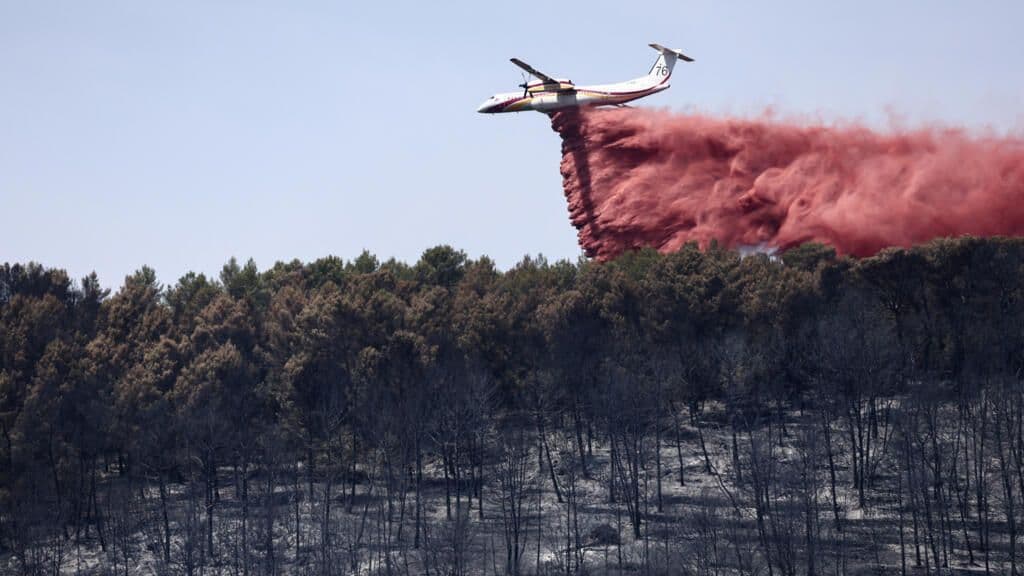
As felt through the first part of the year, 2026 has been astoundingly warm and dry in geographical Europe. Such extreme conditions have favoured the start and spread of wildfires that have ravaged acres of land ranging from the Iberian Peninsula to the Balkans, from the British Isles to Southern Scandinavia.
With rising temperatures spreading polewards, climate change has already had severe depleting effects on European forests, causing unpredictable storm patterns, increased dry events, and even the proliferation of invasive bark beetle species.
A staple incident of recent nature can be seen in this last week’s Fontainebleau forest fire, burning through over two thousand hectares of forest in the South of Paris, ravaging a UNESCO biosphere reserve along with countless acres of soon to be collected crops, and consequently impacting both environmental and economical resources of the site.
Following the summer of 2025, which showed the highest intensity of wildfires since 2006 according to the European Forest Fire Information System, EU countries deployed a total of 22 aircrafts and 5 helicopters to mitigate fires across the upcoming summer, “a failure of society” according to Imperial College London’s Pr. Guillermo Rein.
“Europe did not anticipate a shift towards systematically more flammable landscapes” said Imperial’s Fire Science Professor, “Early signals from southern Europe were framed as exceptional summers or problems of disorderly countries, not as indicators of a changing wildfire regime”.
Now seen throughout the past decade, summers have kept on getting warmer, and wildfire occurrence has severely grown, not only in Europe, but worldwide. As assured by Pr. Rein, global wildfire baselines have shifted, and incoming strategies to solve this crisis need to consider current climatic conditions not as an exception, but our new reality, shifting emerging strategies from prevention to mitigation