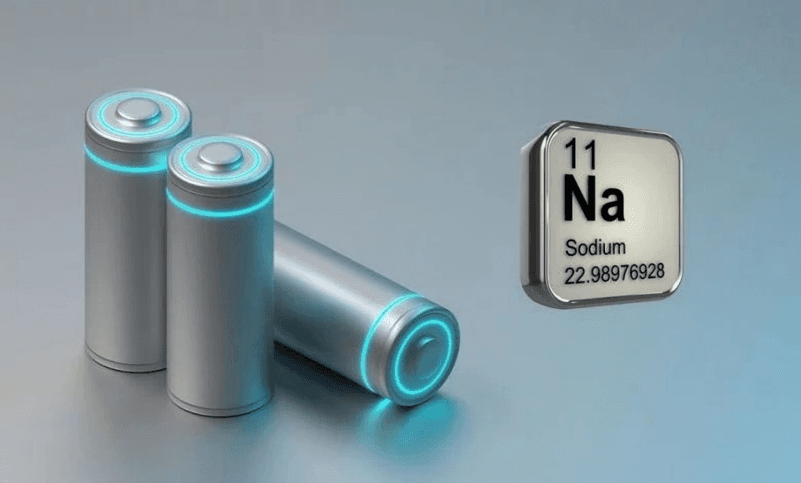
Sodium-ion batteries were supposed to be the West’s way around China. The logic was straightforward: lithium-ion supply chains depend on materials whose production China dominates, which is graphite, cobalt, lithium itself. Sodium is different as it is abundant, extractable from seawater, and no country can corner it. A sodium battery doesn't need any of the materials China has a grip on and that is the whole appeal.
But European and US start-ups saw a chance to get ahead but they didn't take it, and the reason is more interesting than the outcome.
The gap
China's operating and planned sodium-ion gigafactory capacity has risen above 400 gigawatt hours. The rest of the world has 11, according to CRU data, a gap of roughly 36 to 1. China also dominated sodium-ion patent activity in 2025, with CATL the most active applicant, per the Volta Foundation.
There is no resource to control here as sodium is free. China built the capacity anyway and built it well beyond its own demand, as it seeks to retain its position as the global powerhouse for battery manufacturing and design. The clear issue here is that the capacity was committed before the market existed.
What actually determined the outcome
The binding constraint was manufacturing capital deployed ahead of demand. Max Reid, head of battery costs at CRU Group, is blunt: "the West has missed the boat" on being first to sodium-ion, and scaling the supply chain requires "$100mn worth of investment per plant plus, and we're just seeing nothing of that outside China."
Chinese producers including CATL and BYD have been supported by tax breaks. Western ventures were funded by return-sensitive capital that withdrew when execution risk surfaced. Natron Energy, backed by commodity trader Mercuria, collapsed last year shortly after announcing gigafactory plans and Stanford spinout Bedrock Materials closed before it.
Why this matters beyond sodium
Western critical minerals policy is built almost entirely on securing resource access. Sodium-ion is the natural experiment testing whether resource access was ever the real constraint.
Remove the resource dependency entirely and the capacity gap is still roughly 36 to 1, because the actual advantage is willingness to fund manufacturing before demand justifies it. Policy securing lithium supply while leaving that capital gap untouched is addressing the visible dependency rather than the causal one.
The constraint
Sodium-ion is not a lithium substitute. Reid is explicit: "it's not replacing lithium-ion, it's new demand." Lower energy density rules it out for long-range vehicles but its advantages such as safety, rapid charging, cold-weather performance, suit stationary storage and data centres needing quick bursts of backup power. Changan found CATL cells charged 21% faster than lithium at minus 10°C.
Whether the West should compete at all is contested. Christer Bergquist, chief executive of Swedish materials maker Altris, frames it as sovereignty: do economies want to rely on "batteries coming from a potential adversary," or "take a stance now and build up a value chain?" An executive at a
global minerals-focused investment house takes the opposite view: "if China has spent 10 years getting it right — learn from them, buy the tech and learn how to use it... Should we be pumping billions of research dollars into beating the Chinese into battery... Or take the best tech and put that money into actual jobs and facilities?"
What would settle it
UBS expects cost parity by 2027, cell prices falling up to 30% by 2030, and production near 2 TWh by 2035, roughly 19% of the battery market, within a range of about 650 GWh to 2,750 GWh.
Western capacity is not zero with Moll Batterien's German plant beginning next year, which it says will be Europe's first industrial sodium-ion production. Alsym Energy has also secured 19 GWh in commercial commitments across US and UK production.
The test is not whether the West builds, but whether it builds at scale. If UBS's forecast arrives while non-Chinese capacity remains in the tens of gigawatt hours, the conclusion is hard to avoid and it is a conclusion with consequences beyond batteries. The Inflation Reduction Act's domestic content requirements, the Foreign Entity of Concern rules, the EU Critical Raw Materials Act, each rests on the premise that the dependency to break is a resource dependency, but sodium-ion says otherwise. In a chemistry where the West holds no resource disadvantage at all, it is still 36 to 1 behind, because the constraint was never access to materials, but willingness to fund factories before there was a market to justify them.
References
- Hodgson, C., Satoh, R. and Inagaki, K., 'Western companies lag China in sodium battery race', Financial Times, 21 September 2026.
Disclaimer
This piece is published by Howden Research for informational and educational purposes only. It is not investment advice, a personal recommendation, or an investment recommendation within the meaning of UK market abuse rules, and it is not an offer or solicitation to buy or sell any security. Howden Research is not authorised or regulated by the Financial Conduct Authority. Views expressed are those of the author at the date of publication and are subject to change. Contributors may hold positions in the securities or instruments discussed. The value of investments can fall as well as rise. Anyone considering an investment decision should seek advice from an appropriately authorised professional.