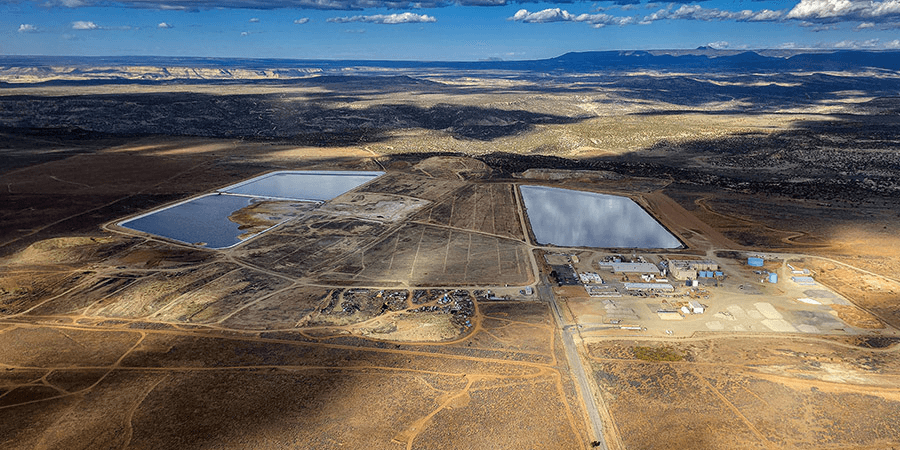
At a time when the United States is seeking to re-establish domestic critical mineral supply chains and reduce reliance on foreign processing capacity, a 1980s-era conventional chemical plant in southeastern Utah has emerged as a central focal point for federal policy and industrial investment.
Located in San Juan County, Utah, five miles north of the Ute Mountain Ute Tribe's White Mesa reservation community, the White Mesa Mill holds a distinct operational position: it is the sole operating conventional uranium mill in the United States.
In an interview with Crux Investor on October 9, 2025, Mark Chalmers, then Chief Executive Officer of Energy Fuels Inc. (NYSE American: UUUU / TSX: EFR), articulated the company's dual-commodity strategy:
“Energy Fuels is a company that is unique from all others because we are focused on building a critical mineral hub that is built around our uranium business but also includes the rare earth suite of elements... If the United States wants to reshore the ability to be independent of China, we have a facility in the United States that's constructed, permitted, and operating to do that.”
Energy Fuels is executing a two-pronged strategy: utilizing White Mesa's established conventional processing infrastructure to generate near-term cash flows from uranium milling while developing commercial-scale separation capacity for rare earth elements (REEs) to address Chinese dominance in permanent magnet supply chains.
However, an evaluation of Energy Fuels will require distinguishing its specific processing assets from broader market structures. Although White Mesa is the sole operating conventional mill in the United States, Energy Fuels faces direct domestic competition from In-Situ Recovery (ISR) facilities, which offer lower capital intensity. However, this market balance is nuanced: conventional milling output is highly campaign-driven and cyclical, leading to dramatic production swings. In 2026, for example, White Mesa's restarted milling campaign is tracking to produce more yellowcake than the rest of the domestic U.S. market combined. Furthermore, U.S. commercial nuclear utilities remain overwhelmingly reliant on foreign imports, which supply over 95% of domestic reactor fuel requirements.
U.S. Foreign Uranium Import Dependency & Policy Landscape
The U.S. commercial nuclear fleet – comprising 94 operating reactors across 54 power plants – generates approximately 19% to 20% of domestic electricity. Sustaining this baseload generation currently requires an estimated 47 to 51 million pounds of yellowcake U3O8 annually.
Despite maintaining the world's largest nuclear power fleet, the U.S. maintains a severe structural deficit in primary uranium extraction. Over the past decade, domestic mine production supplied less than 5% of annual utility consumption, with the remaining volume imported from Canada, Kazakhstan, Russia, Uzbekistan, and Australia. U.S. mine output reached an all-time low of under 100,000 pounds of U3O8 in 2021 before recovering modestly to approximately 700,000 pounds in 2024 and 2.1 million pounds across all domestic extraction sources in 2025.
Geopolitical tensions and supply security concerns have prompted significant federal legislative intervention. In May 2024, Congress enacted the Prohibiting Russian Uranium Imports Act, which placed a statutory ban on imports of low-enriched uranium (LEU) from the Russian Federation. However, the legislation included waiver provisions allowing the U.S. Department of Energy (DOE) to authorize continued Russian imports through January 1, 2028, if no alternative commercial sources are available.
While federal trade restrictions and nuclear fuel reserve programmes aim to incentivize domestic production, U.S. reshoring faces physical constraints. The United States holds approximately 1% of global identified uranium resources. Consequently, domestic supply chains cannot achieve complete autarky; U.S. utilities must remain structurally reliant on primary imports from allied foreign producers, notably Canada and Australia.
Cash Burn, Working Capital, Debt, and Dilution
Evaluating Energy Fuels' financial performance requires analysing operating cash burn, net income trends, balance sheet leverage, and capital structure changes resulting from recent corporate acquisitions.
For the full year 2025, Energy Fuels reported a net loss of $85.63 million on total revenues of $65.92 million, compared to a net loss of $47.77 million in 2024 and net income of $99.86 million in 2023. Operating cash flows for 2025 reflected an operating cash burn of -$89.5 million.
Commenting on the company's financial trajectory and capital deployment in the Q2 2026 earnings release, President and Chief Executive Officer Ross Bhappu – who assumed executive leadership on April 15, 2026 – noted:
> "Our second quarter financial results reflect continued strong performance in our uranium segment, including industry leading low production costs, and actions we have taken to deliver on becoming the first, true, rare earth mine-to-magnet platform in the West. The continued investment in our transformation into a vertically integrated global critical materials company resulted in a net loss driven primarily by transaction-related costs associated with our planned acquisitions and higher operating expenses..."
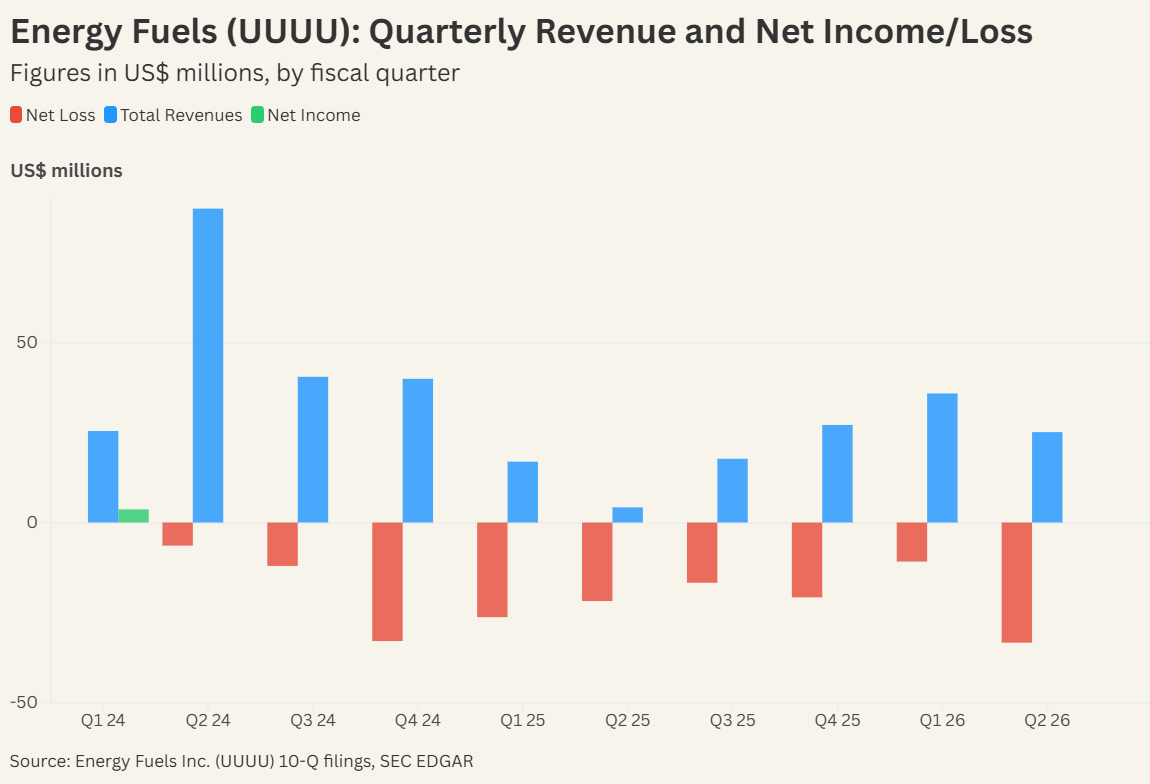
Company management attributed these ongoing net losses to elevated SG&A expenses, mill maintenance during processing pauses, international asset integration costs, and transaction fees associated with corporate M&A.
As of June 30, 2026, Energy Fuels reported net working capital of $996.01 million. An analysis of the working capital components reveals that liquid assets are primarily held in marketable securities rather than unencumbered cash:
- Cash and Cash Equivalents: $58.40 million.
- Marketable Securities: $878.30 million, comprising short-term interest-bearing liquid securities and publicly traded uranium equities.
- Trade Receivables & Inventories: $15.10 million in trade receivables and $75.00 million in physical yellowcake and vanadium product inventories.
- Current Liabilities: $37.03 million
A crucial counterweight to this working capital figure is the company's long-term debt obligation. In October 2025, Energy Fuels closed an oversubscribed offering of $700.0 million in 0.75% Convertible Senior Notes due 2031. While this note offering provided gross cash proceeds to fortify liquid reserves, it established a substantial senior debt liability that must be serviced ($5.25 million in annual interest) and eventually redeemed or converted, adjusting the company's net unencumbered liquidity.
Capital expansion and M&A activity have also introduced share dilution and execution risks alongside specific strategic capabilities:
1. Australian Strategic Materials Ltd. (ASM): Completed on August 28, 2026, this transaction was structured as an all-equity share exchange where ASM shareholders received 0.053 UUUU shares per ASM share, expanding the total common share count. Strategically, ASM provides upstream rare earth ore development (the Dubbo project in Australia) and commercial metallization capability in South Korea, allowing Energy Fuels to convert separated rare earth oxides directly into metallic alloys.
2. Vacuumschmelze (VAC): On June 23, 2026, Energy Fuels entered into a definitive agreement to acquire European magnet producer Vacuumschmelze for approximately $1.9 billion in cash and stock. VAC brings downstream permanent magnet manufacturing facilities in South Carolina, Europe, and Asia, completing Energy Fuels' vision of a fully integrated ex-China mine-to-magnet platform. However, integrating international magnet manufacturing operations and funding capital improvements at VAC's Sumter facility present operational execution risks and potential further equity or debt financing requirements.
3. Federal Financing Commitments: In June 2026, Energy Fuels announced a conditional, senior-secured loan commitment of up to $725 million from the US Department of Defense’s Office of Strategic Capital (OSC). This funding represents a conditional, non-binding commitment subject to technical diligence, definitive legal documentation, and compliance with federal conditions precedent prior to capital disbursement.
Revenue Dynamics, U3O8 Margins, and Utility Contracting Risks
A central factor in Energy Fuels' near-term financial trajectory is its conventional uranium segment. However, current market dynamics present commercial risks regarding utility contracting behaviour.
In 2025, commercial utilities globally placed approximately 82 million pounds of U3O8 under long-term contracts by early December, representing only about a 50% replacement rate, highlighting a significant under‑contracting relative to annual needs. Rather than leading to an immediate procurement panic, this market structure reflects a stalemate where utilities have resisted entering long-term fixed contracts at elevated price ceilings ($85–$95/lb), while primary producers remain reluctant to commit long-term volume at lower prices. This contracting bottleneck creates revenue volatility for Energy Fuels, exposing uncommitted future production to spot market fluctuations while the company maintains its high fixed mining and milling overheads.
Federal initiatives – such as the Department of Energy’s $80 billion goal to deploy 10 new commercial reactors starting in 2030 – aim to expand domestic baseload power, but new capacity remains constrained by the capital-cost and schedule overruns that have historically affected project development. For example, Georgia’s Plant Vogtle Units 3 and 4 required seven additional years to complete with costs climbing to ~$15,000 per kilowatt. Small Modular Reactors (SMR), regarded as the 'nimble' future of nuclear, have faced project cost escalations ranging from 300% to 700%. Consequently, new nuclear construction cannot meet near-term power deficits.
This severe near-term execution bottleneck means nuclear energy cannot build new reactors fast enough to keep pace with AI power demands. Unable to wait a decade for new builds, tech giants are instead scrambling to secure existing nuclear baseload: Microsoft's landmark agreement to restart Pennsylvania's shuttered Three-Mile Island (Unit 1) by 2028, alongside similar plans to revive Michigan's Palisades Power Plant by late 2026, has pulled existing baseload capacity directly off the public grid. For Energy Fuels, this commercial bottleneck leaves future volume exposed to spot price swings while the company maintains heavy fixed operational costs.
Energy Fuels restarted conventional uranium processing campaigns at White Mesa in late 2025, producing 1.015 million pounds of U3O8 for the year. In the first half of 2026, the company produced 1.7 million pounds of yellowcake, remaining within its full-year operational guidance of producing 1.5-2.5 million pounds.
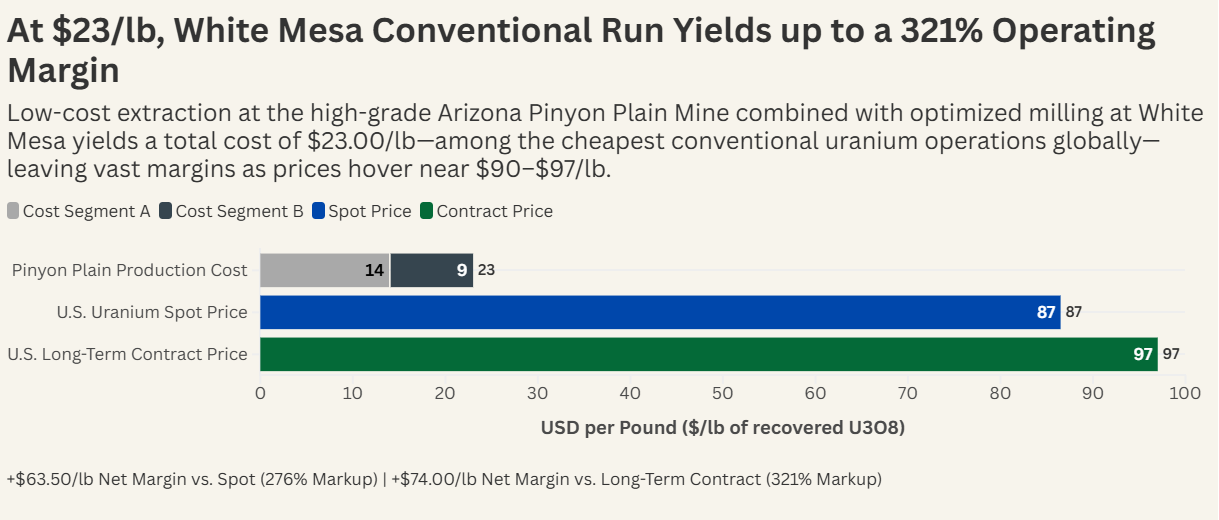
Primary conventional ore feeds are drawn from the Pinyon Plain Mine in Coconino County, Arizona. Pinyon Plain contains high-grade breccia pipe mineralization (averaging 1.62% U3O8, allowing Energy Fuels to extract, transport, and process ore at an estimated all-in cost of $23.00 to $30.00 per pound of U3O8. With uranium spot prices trading near $89.55 per pound around mid to late 2026, these production costs generate strong segment-level operating margins.
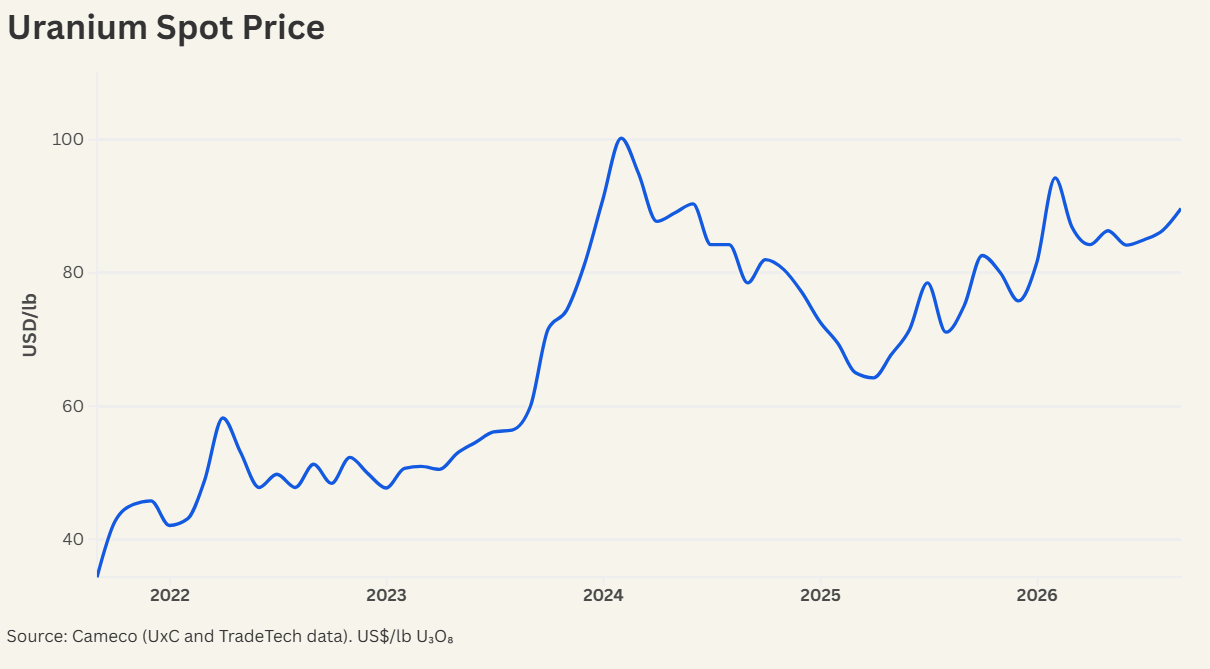
While low extraction costs at Pinyon Plain support attractive mine-level margins at current uranium prices, these aren’t sufficient for consolidated profitability. Group-level cash generation remains constrained by corporate overhead, ongoing mill maintenance, rare-earth development capital expenditure, M&A-related transaction costs and debt service on the $700 million convertible notes, alongside potential additional financing to fund rare-earth circuit expansion and downstream magnet assets.
Conventional Milling vs. In-Situ Recovery (ISR) & Competitor Analysis
A rigorous assessment of Energy Fuels requires comparing conventional milling against In-Situ Recovery (ISR) mining, which dominates domestic U.S. uranium extraction.
In 2025, ISR accounted for approximately 60% of global uranium production and nearly all historical U.S. output over the past two decades. ISR operates by circulating an oxidized leaching solution through permeable underground sandstone formations, dissolving uranium in situ, and pumping the solution to surface ion-exchange facilities. ISR eliminates physical ore excavation, crushing, grinding, and surface tailings generation, resulting in significantly lower upfront capital expenditure and greater operating flexibility.
By contrast, conventional milling involves capital-intensive underground or open-pit mining, physical ore transport over long distances (>1,000 km from Pinyon Plain to White Mesa), chemical leaching, and long-term surface tailings management. Conventional mills operate on campaign schedules; White Mesa paused uranium ore milling throughout 2023 and most of 2024 to accumulate sufficient ore stockpiles before resuming processing in 2025.
This operational contrast was visible in 2024 when ISR producer enCore Energy restarted its South Texas facilities (Rosita and Alta Mesa), producing 288,589 pounds of U3O8 during a period when White Mesa's uranium circuits were paused. Once campaign milling resumed at White Mesa, Energy Fuels produced 1.015 million pounds in 2025 and 1.7 million pounds in the first half of 2026.
Rival conventional mills face high regulatory and financial barriers to reactivation:
1. Shootaring Canyon Mill (Anfield Energy): Located in Garfield County, Utah, Shootaring Canyon has been on standby since 1982. Anfield submitted an application in April 2024 to amend its radioactive materials licence to increase throughput to 1,000 tonnes per day. Recommissioning requires substantial capital, mechanical rebuilding, and environmental reviews.
2. Sweetwater Mill (Uranium Energy Corp - UEC): Acquired from Rio Tinto in late 2024 for $175 million, Sweetwater has been idle for over 40 years. Reopening requires extensive regulatory licence renewals, tailings capacity expansion, and refurbishment.
Because competitor mills remain years away from potential operational restarts, near-term conventional ore developments – such as Anfield's Velvet-Wood project in San Juan County (approved by BLM in May 2025) – may rely on toll-milling arrangements at White Mesa, providing Energy Fuels with third-party processing revenue.
Rare Earth Elements & The China Dependency: Feedstock & Execution Risks
Energy Fuels' rare earth initiative aims to address Chinese concentration in critical materials. China currently controls over 70% of global rare earth mining, 85% of separation capacity, and more than 90% of complex NdFeB permanent magnet manufacturing.
White Mesa's rare earth strategy centres on processing monazite sand, a mineral byproduct of heavy mineral sands mining containing ~50% total rare earth oxides (TREO). Monazite contains elevated concentrations of high-value magnet feedstocks, including neodymium-praseodymium (NdPr), dysprosium (Dy), and terbium (Tb). However, monazite is naturally radioactive, containing 0.2% to 0.5% uranium and 4% to 8% thorium.
Because White Mesa possesses an 11e.(2) byproduct licence as a conventional uranium mill, it can legally handle radioactive feedstocks, extracting uranium for nuclear fuel, isolating thorium, and refining separated rare earth oxides.
The company's REE operational milestone timeline includes:
- April 2024: Commissioned Phase 1 circuit, achieving pilot commercial separation of light rare earths (1,000 tonnes per annum NdPr capacity).
- August 2025 / March 2026: Produced pilot kilograms of 99.9% pure dysprosium (Dy) and terbium (Tb) oxides.
- July 2026: Initiated construction on a $104 million Phase 2 heavy rare earth expansion to separate commercial-scale Dy, Tb, Sm, Eu, and Gd.
Nearshoring chemical separation to White Mesa directly targets China’s midstream refining bottleneck, where Beijing currently controls over 85% of global processing and forces Western mines to export raw concentrates overseas. By cracking monazite sands domestically, Energy Fuels can provide Western original equipment manufacturers (OEMs) and defence contractors with a verified, non-Chinese supply chain for critical heavy rare earths like dysprosium and terbium. This domestic processing capability insulates industrial buyers from tightening Chinese export restrictions while allowing Energy Fuels to capture Western pricing premiums for origin-verified materials.
Despite engineering progress, the REE strategy faces major feedstock availability risks:
1. Feedstock Bottlenecks: Current monazite deliveries from Chemours (~800 to 1,000 tpa) are sufficient only for pilot and Phase 1 trial runs. Operating Phase 2 commercial circuits at capacity requires 10,000 to 30,000 tpa of monazite feedstock.
2. Upstream Project Risks:
Donald Project JV (Australia): Energy Fuels' joint venture with Astron Corporation requires a Final Investment Decision (FID) and substantial capital commitment to build mining and concentration infrastructure.
Vara Mada Project (Madagascar): Subject to Malagasy parliamentary approval for fiscal stability agreements, environmental permitting, and political country risk.
Bahia Project (Brazil): Early-stage exploration asset requiring extensive drilling, environmental licensing, and technical feasibility studies.
Without secured, long-term monazite supply agreements, White Mesa's multi-million dollar REE separation circuits face capacity underutilization risks.
Primary Regulatory, Environmental, and Tribal Realities
The expansion of operations at White Mesa has maintained significant regulatory scrutiny and local environmental opposition. The mill is situated five miles north of the Ute Mountain Ute Tribe's reservation community of White Mesa. Tribal leadership and community advocacy groups have formally called for the mill's closure, citing fears of groundwater contamination at sacred seeps like Entrance Spring, elevated radon emissions, and long-term health risks. These environmental concerns are compounded by cultural distress over historical disturbances to ancestral burial grounds and the ongoing transport of radioactive materials across sovereign tribal lands.
Beyond this, primary regulatory and environmental factors include:
1. Tailings Infrastructure & Liners: The 284-acre tailings facility consists of several waste impoundment cells. Cells 1, 2, and 3 were constructed in the early 1980s using single-layer 30-mil PVC liners, which do not meet modern 40 CFR 192 (UMTRCA) standards requiring double-lined systems with leak detection. Groundwater monitoring by INTERA and the USGS has identified localized plumes of nitrate, chloride, and uranium in shallow aquifers near Entrance Spring.
2. EPA CERCLA Compliance Actions: In December 2021, the EPA Region 8 issued an unacceptability determination under the CERCLA Off-Site Rule, prohibiting White Mesa from receiving Superfund wastes. The enforcement action resulted from violations of Clean Air Act Subpart W (40 CFR 61), specifically a failure to maintain a mandatory 1-meter liquid cover over exposed tailings in Cell 4B, leading to elevated radon-222 emissions. Energy Fuels undertook corrective actions, restoring the liquid cover and regaining CERCLA compliance in July 2022.
3. Alternate Feed Processing: Energy Fuels receives $5 million to $15 million annually in recycling fees from third-party industrial generators to process low-level radioactive waste materials. While the mill recovers trace uranium, over 99% of the material volume – containing heavy metals and thorium-232 – is permanently disposed of in White Mesa's tailings cells.
4. Ore Transport Friction: In July 2024, the transport of high-grade uranium ore from the Pinyon Plain Mine across the Navajo Nation to White Mesa led to an executive order and moratorium from Navajo Nation President Buu Nygren, citing a lack of advance notification and emergency response coordination. Trucking was temporarily suspended before operations resumed under updated transport protocols.
Conclusion
Energy Fuels occupies a strategic position within the U.S. nuclear and critical minerals supply landscape. Its ownership of the White Mesa Mill provides a unique dual-processing platform capable of handling conventional uranium ore and monazite-derived rare earth elements.
However, evaluating the company's long-term trajectory requires balancing these operational assets against concrete financial and execution risks:
- Ongoing Cash Burn: Persistent net losses ($85.63M in 2025; $33.38M in Q2 2026) driven by high SG&A, maintenance overhead, and M&A integration costs.
- Balance Sheet Leverage & Dilution: A $700 million convertible senior note liability, share count expansion from equity-funded M&A (ASM), and capital commitments required for VAC integration.
- Feedstock Constraints: Execution risks surrounding upstream monazite supply (Donald FID, Madagascar political risk) necessary to utilize Phase 2 REE capacity.
- Commercial & Regulatory Exposure: Utility contracting stalemates exposing uranium sales to spot volatility, paired with ongoing regulatory oversight and local tribal opposition.
Ultimately, Energy Fuels represents an asset-rich infrastructure play operating at the intersection of federal industrial policy and volatile global commodity markets, where long-term value creation depends on disciplined capital allocation, secure feedstock procurement, and strict regulatory compliance.
References
- Crux Investor (Henry Mann)
Energy Fuels: America's Uranium Backbone at the Centre of a Critical Minerals Renaissance
https://www.cruxinvestor.com/posts/energy-fuels-americas-uranium-backbone-at-the-centre-of-a-critical-minerals-renaissance - Trading Economics
Uranium – Price – Chart – Historical Data – News
https://tradingeconomics.com/commodity/uranium - Energy Fuels Inc.
Financials – Quarterly, Annuals and Sustainability Reports
https://investors.energyfuels.com/financials - Energy Fuels Inc.
Energy Fuels Announces Q2-2026 Results
https://investors.energyfuels.com/2026-08-05-Energy-Fuels-Announces-Q2-2026-Results - Energy Fuels Inc.
Energy Fuels Announces 2025 Results and 2026 Guidance
https://investors.energyfuels.com/2026-02-26-Energy-Fuels-Announces-2025-Results-and-2026-Guidance - Crux Investor (Henry Mann)
Energy Fuels' First US Terbium Oxide Production: 7 Things You Need to Know
https://www.cruxinvestor.com/posts/energy-fuels-first-us-terbium-oxide-production-7-things-you-need-to-know - Energy Fuels Inc.
Commercial-Scale “Heavy” Rare Earth Plant Now Under Construction in Utah
https://investors.energyfuels.com/2026-07-29-Commercial-Scale-Heavy-Rare-Earth-Plant-Now-Under-Construction-in-Utah - World Nuclear News (Claire Maden)
Fast-Tracked US Uranium Project Receives Federal Approval
https://www.world-nuclear-news.org/articles/fast-tracked-us-uranium-project-receives-federal-approval - Inside Climate News (Dylan Baddour)
Arizona Regulators Are Raising Contaminant Limits for a Uranium Mine With an Arsenic Problem
https://insideclimatenews.org/news/10072026/arizona-raises-uranium-mine-contaminant-limits/ - MIT Climate Portal
Utah Has the Last Conventional Uranium Mill in the Country. What Does It Do? https://climate.mit.edu/posts/utah-has-last-conventional-uranium-mill-country-what-does-it-do - KFF Health News / NPR (Melissa Bailey)
Drive for Nuclear Power Boosts Uranium Industry – and Tribal Health Concerns in Southwest
https://kffhealthnews.org/public-health/tribal-health-concerns-utah-uranium-mining-industry/ - Grand Canyon Trust
Bears Ears and the Radioactive Waste Dump Next Door
https://www.grandcanyontrust.org/blog/bears-ears-and-radioactive-waste-dump-next-door/ - High Country News (Rosemary Winters)
Uranium Mill or Dump?
https://www.hcn.org/issues/issue-267/uranium-mill-or-dump/ - US Environmental Protection Agency, Region 8
Comprehensive Environmental Response, Compensation, and Liability Act (CERCLA) Off-Site Rule Unacceptability Final Determination: White Mesa Mill
https://www.grandcanyontrust.org/sites/default/files/resources/EPA-final-White-Mesa-Mill-CERCLA-unsuitablility-determination-7-18-22.pdf - US Environmental Protection Agency / Federal Register
Revisions to National Emission Standards for Radon Emissions from Operating Mill Tailings
https://www.federalregister.gov/documents/2014/05/02/2014-09728/revisions-to-national-emission-standards-for-radon-emissions-from-operating-mill-tailings - Crux Investor (Ryan Charles)
US Critical Minerals Designation & Nuclear Funding Position Uranium for a 2026 Contracting Cycle https://www.cruxinvestor.com/posts/us-critical-minerals-designation-nuclear-funding-position-uranium-for-a-2026-contracting-cycle
Disclaimer
This piece is published by Howden Research for informational and educational purposes only. It is not investment advice, a personal recommendation, or an investment recommendation within the meaning of UK market abuse rules, and it is not an offer or solicitation to buy or sell any security. Howden Research is not authorised or regulated by the Financial Conduct Authority. Views expressed are those of the author at the date of publication and are subject to change. Contributors may hold positions in the securities or instruments discussed. The value of investments can fall as well as rise. Anyone considering an investment decision should seek advice from an appropriately authorised professional.