
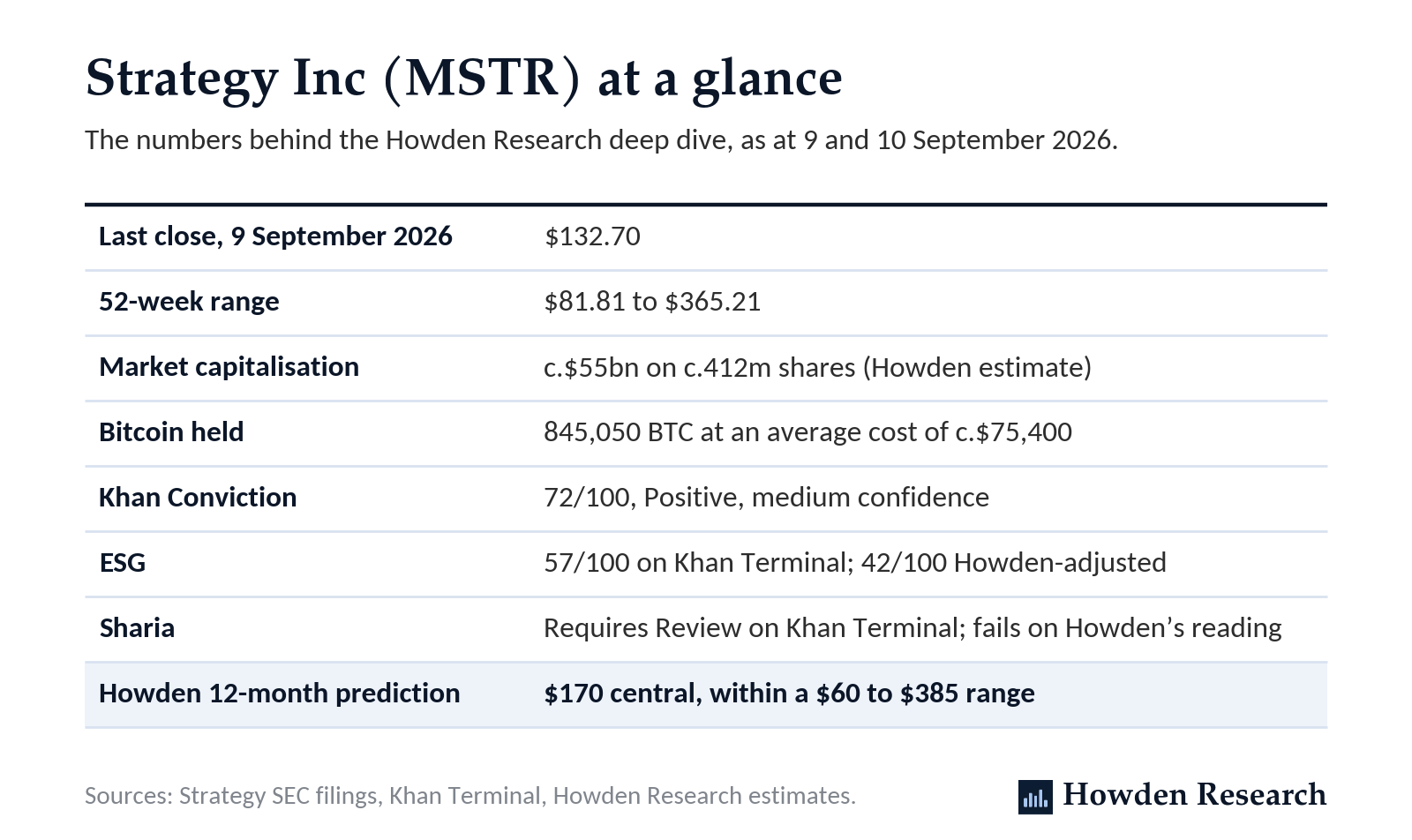
For the better part of four years, Michael Saylor’s advice on bitcoin could have fit on a T-shirt: don’t sell. In early June, Strategy sold 32 bitcoin.
About $2.5m worth of bitcoin, from a pile worth more than $50bn. The market reacted as though it had read a confession. By late July the company had sold $218m of bitcoin to help cover preferred dividends and had given the habit a formal name, the BTC Monetisation Program. Then, on 31 August, it bought 4,603 coins at an average of $80,318. That's about $16,000 a coin more than it received for the 1,638 it sold in the last week of July.
Selling at $64,000 and buying back at $80,000 won’t feature in anyone’s pitch deck. Chief executive Phong Le called issuing MSTR at a premium to buy bitcoin“the right trade at this point in time”, and on the narrow arithmetic he may be right. But the episode answered a question bulls spent 2025 avoiding. Whathappens to the world’s largest corporate bitcoin treasury when its funding market seizes?
This report asks what an MSTR share actually is in September 2026, what it might be worth in twelve months, and how it looks through two lenses the bull case rarely applies: climate and sharia compliance. My conclusion surprised me. The balance sheet is in better shape than the share price suggests.
I've tracked my own crypto positions since 2022, long enough to have lived through one full cycle from the inside. This is the first time the most interesting line in a Strategy has been denominated in dollars.
The Quarter the engine stalled
Strategy’s second-quarter results on 30 July looked catastrophic and meant very little. The software business brought in $122.4m of revenue, a whisker below forecasts. The net loss was about $8.6bn, or $24.45 a share, against a Street expectation of a small profit, almost entirely because an $8.32bn unrealised loss on bitcoin ran through the income statement. For the half year, the unrealised loss was $22.77bn. Under fair-value accounting, Strategy’s P&L is a bitcoin chart with a software company stapled to the bottom.
The numbers that mattered sat elsewhere. Bitcoin per share rose to 210,824 Satoshis from 201,170 at the end of March, the metric management most wants you to watch. Convertible debt fell 18% to $6.7bn. And the USD reserve, which didn’t exist a year ago, reached $3.75bn by results day and $5.10bn by 7 September, with another $1.44bn in a separate cash pool.
That reserve is the real story.
Strategy's growth model runs on perpetual preferred stock, above all STRC, a variable-rate instrument sold to income investors at a $100 stated amount. Sell preferred near par, buy bitcoin, repeat. This summer STRC fell as low as $74.57. Once the preferred trades at a deep discount, issuing more becomes ruinous, and the machine stops.
Management’s repair job was conventional, almost old-fashioned. Stop buying bitcoin for roughly ten weeks. Hoard dollars. Hold the STRC dividend at 12%. Buy the preferred back below par, under an authorisation doubled to $2bn this week after another $176m of repurchases. Management now says net debt is zero. Dividends and interest run at roughly $1.7bn a year, so the reserve alone covers about three years, four if you include the cash pool. A credit analyst would have asked for exactly this in 2025.
Common shareholders paid for it. Class A shares outstanding rose from about 292m at the end of 2025 to 364.6m by 24 July, and a further 18.3m were sold in a single week in August. Roughly a third more shares in eight months.
Expect the third quarter to look like the second held up to a mirror. Strategy's June carrying value implies bitcoin at about $59,000; it trades just under $79,000 today. If it holds there to 30 September, Strategy should book an unrealised gain in the region of $16bn, and every $1,000 on the bitcoin price is worth about$845m either way. There will be headlines about a record profit. Give them exactly the weight you gave the loss.
One consequence is worth modelling now. S&P 500 eligibility requires positive GAAP earnings in the latest quarter and across the trailing four quarters, and GAAP losses have kept Strategy out. On my arithmetic, the first-half losses only wash out of the trailing sum if bitcoin finishes somewhere in the high $80,000s. Below that, inclusion is a 2027 conversation at best.
What an MSTR share actually is
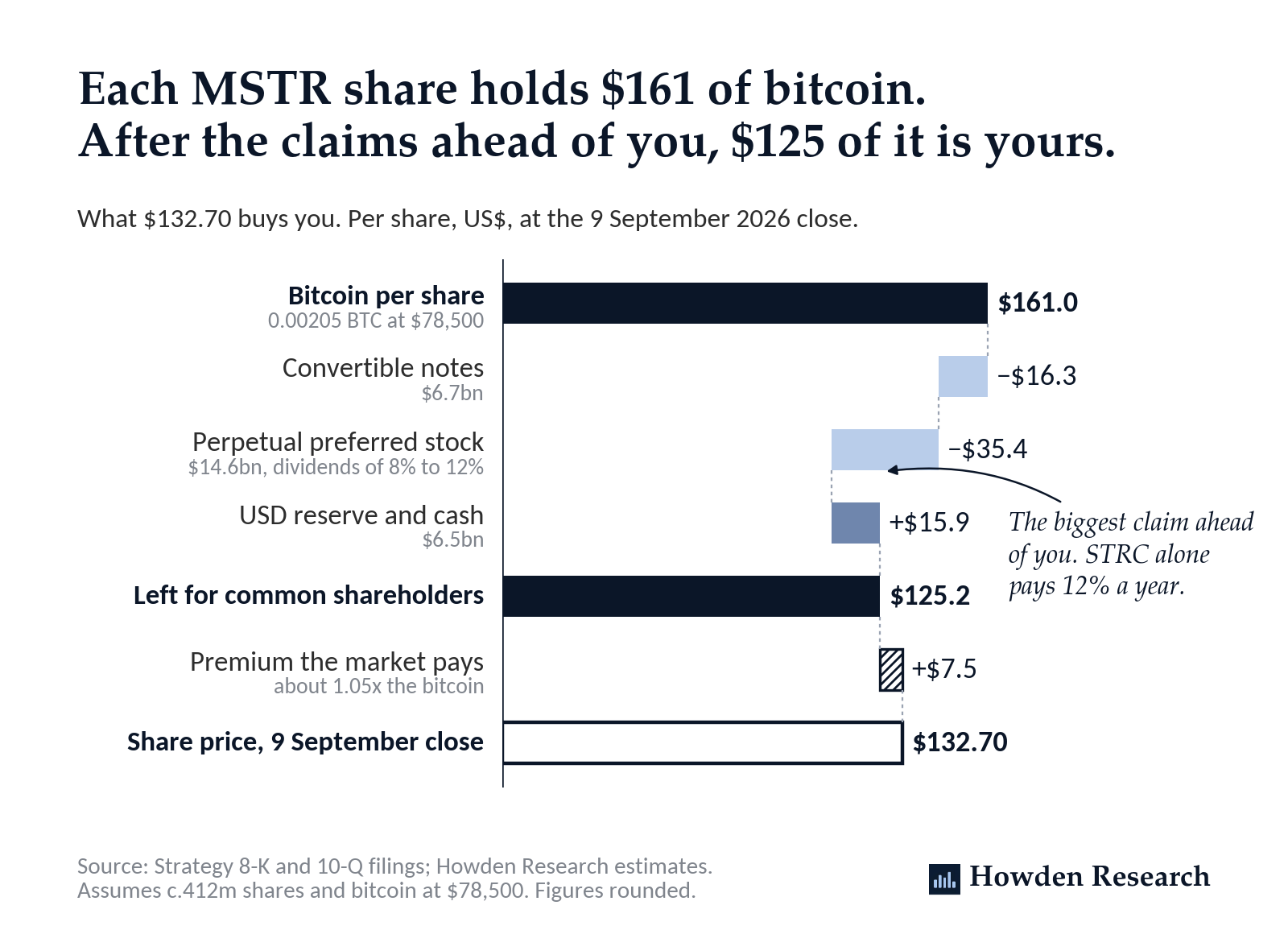
Strip away the vocabulary and one share is a claim on about 0.00205 bitcoin (845,050 coins over roughly 412m shares), worth about $161 at today's price. Ahead of it sit $6.7bn of convertible notes and around $14bn to $15bn of perpetual preferred, partly offset by $6.5bn of dollars. Net senior claims come to roughly $36 per share.
So, the market pays $133 for $161 of bitcoin less $36 of claims. That’s about 1.05x enterprise value to bitcoin, the measure Strategy calls mNAV; third-party trackers put it nearer 1.1x within a 0.95x to 1.43x range over the past year. On a cruder basis, the common equity is worth about 83 cents for every dollar of bitcoin on the balance sheet.
Two things follow. The first is gearing: a share whose value is bitcoin minus fixed claims moves further than bitcoin in both directions. The second is that thepremium moves with sentiment, so it shrinks precisely when bitcoin falls. When bitcoin dropped about a quarter, from $90,000 to $67,000, MSTR fell roughly60%, from around $300 to $121. Double hit. That’s why a 1.05 multiple is less of a bargain than it sounds if the cycle has further to fall, and more of one if you think the bottom is in.
Khan Terminal puts MSTR’s adjusted beta at 1.78 (raw 2.16) against the market, with an R² 0f 0.15. In plain English, the stock market explains about 15% of how this share moves. Bitcoin explains most of the rest. Any CAPM cost of equity for this company is a number looking for a business.
The Khan Conviction reading
Some of the analysis here comes from Khan Terminal, the financial research platform I founded. Its headline signal, Khan Conviction, exists because sell-sideratings are licenced for personal use and can’t be republished. It reads what can be published instead: what insiders did (SEC Form 4, 35% weight), how a curated set of well-known institutional mangers moved last quarter (SEC 13F, 25%), and what the company is worth of the terminal’s own valuation model (40%), discounted at a rate built from the live Treasury yield. Look out for Khan Terminal in the coming months.
On MSTR it reads 72 out of 100: Positive, with medium confidence. The breakdown is more useful than the number.
Institutional positioning scores 80, with the tracked mangers adding to their positions last quarter.
Insider conviction scores 67. Six insiders bought $5.8 million on the open market over the past twelve months; three sold $20.0m at their own discretion, equivalent to about 5.4 basis points of the company; a further 70 sales under pre-arranged 10b5-1 plans are excluded. One caveat from reading the filings myself. Form 4s cover every security Strategy issues, and the most visible insider purchase this summer was Phong Le’s purchase of 11,000 STRC shares at about $90.80 in June. That's a purchase of the preferred. An insider buying the senior security at a discount is voting for the dividend, and only indirectly for theequity. I'd treat 67 as a ceiling.
Valuation couldn't be scored at all, so the 72 is computed over 60% of the model. Prefilled from Strategy’s 10-K, the terminal’s discounted-cash-flow engine produced an EBIT margin of minus 1,140.8% (fair-value losses sit in operating expenses), an intrinsic value of minus $243.69 a share, and zero Monte Carlo draws out of 2,000 above the spot price. When a model returns a negative value for a company sitting on $66bn of bitcoin, it is telling you something important: this was never a cash-flow story. The software business, on $477m of trailing revenue, is a rounding error in any sum of the parts. Declining to score it was the correct output.
ESG: a software scorecard on a bitcoin balance sheet
Khan Terminal’s model ESG estimate is 57, “Average”. Governance scores 62 (a neutral 60, plus 12 for debt to equity of 0.2x, minus 10 for a return on equity minus 9%). Environmental (54) and Social (52) come from the sector baselines. For thousands of companies that’s a sensible default. For this one, the baseline misses the only environmental fact that matters.
The Cambridge Centre for Alternative Finance estimates that bitcoin mining uses about 138 TWh of electricity a year and produces around 39.8 MtCO2e. Theharder question is how much of that belongs to a holder. The most developed method, the “hybrid allocation” set out by the Crypto Carbon Ratings Institute and South Pole, splits a proof-of-work network’s footprint according to how miners get paid: the block-subsidy share goes to holders, the fee share to those transacting. Fees are a sliver of miner revenue. Nearly everything lands on holders.
Strategy owns about 4.2% of the roughly 20.1m bitcoin mined so far. Apply the method and its attributable footprint is around 1.6 MtCO2e a year, roughly what350,000 typical petrol cars emit on the US EPA’s figure of 4.6 tonnes each. Put a $100 internal carbon price on it and you get about $160m a year. That's a third of the software business's revenue.
I'm genuinely unsure how much weight this deserves. Holding a coin burns no electricity at the margin; the subsidy gets paid whether Strategy owns 4% of supply or none of it. The counterargument is economic rather than physical. Strategy’s buying is part of the bitcoin price, the price sets miner revenue, and miner revenue decides how many machines run. A buyer that has absorbed 4% of all bitcoin ever mined isn’t a bystander to the hash rate. The energy mix has improved, too: Cambridge puts sustainable sources at 52.4% of mining electricity (42.6% renewables, 9.8% nuclear), natural gas, at 38.2%, is the largest single source.
Then comes this year’s twist. By mid-summer, bitcoin’s 30-day average hash rate had fallen to about 940 EH/s, roughly 12% below its December 2025 peak, as recorded-low hash price pushed miners towards AI hosting. Listed miners have now announced more than $70bn of AI and high-performance computing contracts. Strategy’s attributable emissions will probably fall this year without it lifting a finger.
Does that make it greener? Only in the accounting.
The megawatts haven’t disappeared. They've changed tenants. The IEA expects global data-centre electricity to use more than double from about 415 TWh in 2024 to around 945 TWh by 2030. I grew up in Slough, and the data centre cluster you can see from the Trading Estate is a daily reminder that compute is heavy industry with nicer fences. I've pushed our local MP on mandatory sustainability audits over those sites; so far, the construction has moved faster than thepolitics. A grid connection vacated by a bitcoin miner in Texas and taken by an AI tenant counts as a reclassification. The atmosphere doesn’t notice thedifference.
There's a regulatory irony here too. Under MiCA, EU crypto-asset service providers must disclose the energy consumption of a coin’s consensus mechanism, with renewable-share and greenhouse-gas indicators added above 500,000 kWh a year. Buy bitcoin through a licensed exchange in Frankfurt and you get a sustainability disclosure. But MSTR in a UK stocks and shares ISA and you get a software company’s ESG profile. MSTR is, in effect, bitcoin with the MiCAdisclosure removed.
Governance deserves a haircut too. The +12 for low debt treats $14bn to $15bn of cumulative preferred, paying 8% to 12%, as equity; to a common shareholder it behaves like debt. Saylor controls 35.8% of the voting power through ten-vote class B shares while owning about 5% of the equity. The share count is up by a third in eight months. In fairness, few companies disclose more often: 8-Ks and a live dashboard put most of the S&P to shame on transparency.
My adjusted reading: Environmental 25, Social 52, Governance 42 giving a score of 42. Below average, which is closer to where an honest screen should land.
Index providers are moving faster than ESG raters. MSCI’s August consultation would bar “non-operating companies” from its global indexes using five balance-sheet and cash-flow ratios, without naming any asset class; four flags make a company ineligible. Run on May 2026 data, it deletes three names: Strategy (about $23.9bn of float-adjusted value), Metaplanet and Yellow Cake, the London-listed uranium holder. Strategy's reply was characteristically blunt: “Bitcoin doesn't need MSCI. Neither does Strategy.” A screen that can’t tell a warehouse of nuclear fuel from a warehouse of bitcoin is, if nothing else, consistent.
Sharia: “Requires Review” is generous
Khan Terminal flags MSTR as Requires review. Business activity passes as non-financial, both balance-sheet ratios pass, and the impermissible-income test returns N/A because Strategy doesn’t separately tag interest income in its XBRL data. We built the screen to say so when it can’t see something, and that N/A is doing honest work. Look at what it can’t see, and the verdict tends to harden.
Start with the preferred. AAOIFI’s standards prohibit issuing shares with financial priority in profit distribution or liquidation, which describes STRC, STRF, STRK, STRD, and STRE precisely. Count them alongside the $6.7bn of convertibles and interest like obligations reach roughly 39% of market capitalisation, above AAOIFI’s 30% ceiling and the 33% used by Dow Jones-style screens.
Then the dollars. Strategy holds about $6.5bn against trailing revenue of $477m, so the 5% impure-income limit is roughly $24m. If more than about a tenth of that cash earns anything like Treasury bill rates, the test fails. I'd be surprised if it didn’t.
And underneath sits bitcoin itself, on which scholars remain divided. MSTR pays no common dividend, so the terminal’s purification guidance has nothing to act on anyway. Purification can clean a dividend. It can’t clean a capital structure. My two pence: compliant but difficult to defend. But take that as you will and consult your trusted scholars.
What moves the stock next
The calendar is unsually crowded. US inflation data lands on 11 September (this analysis comes from just before the data was released), and the FederalReserve meets on 16 September with futures pricing roughly a 55% chance of a quarter point hike under Chair Kevin Warsh, after a July PCE inflation reading of 3.7%. a hike hurts twice. Bitcoin trades as a liquidity asset, and a 12% STRC yield looks less special when cash pays more.
MSCI’s comment period closes on 30 September, with a final methodology due on 16 October. Estimates of MSCI-driven passive selling run from $1.8bn to $2.0bn, and a JP Morgan note last November put the figure at $8.8bn if FTSE Russel and S&P Dow Jones followed. Reports differ on timing; some point to November, though the draft gives existing constituents two consecutive failing annual filings before removal. I expect the headline risk to arrive well before any flows.
Third quarter results should follow in late October, with the gain described above. Then there’s the cycle. Bitcoin's last two bear markets bottomed 381 and 385 days after they began, which puts this one’s historical window in October and November. This cycle’s drawdown, just over 50% at the June trough, has been theshallowest yet. That may mean the low is already in. It may also mean the market hasn’t finished.
Further out, three things. Whether STRC holds par long enough to restart issuance, the only route to bitcoin-per-share growth that doesn’t dilute the common. S&P eligibility in 2027. And the April 2028 halving, which again cuts the subsidy that pays for network security. Startegy's only real asset relies on a security budget designed to shrink; price has always made up the difference, and it has to keep doing so.
Howden Research prediction
Let’s get the legal out of the way. This is a prediction, not investment advice and not a price target. It's my best estimate of where MSTR trades in September 2027, built from four inputs: the bitcoin price, the multiple the market pays (mNAV), bitcoin per share, and net senior claims per share, which rise by roughly $4 a year as dividends drain the reserve.
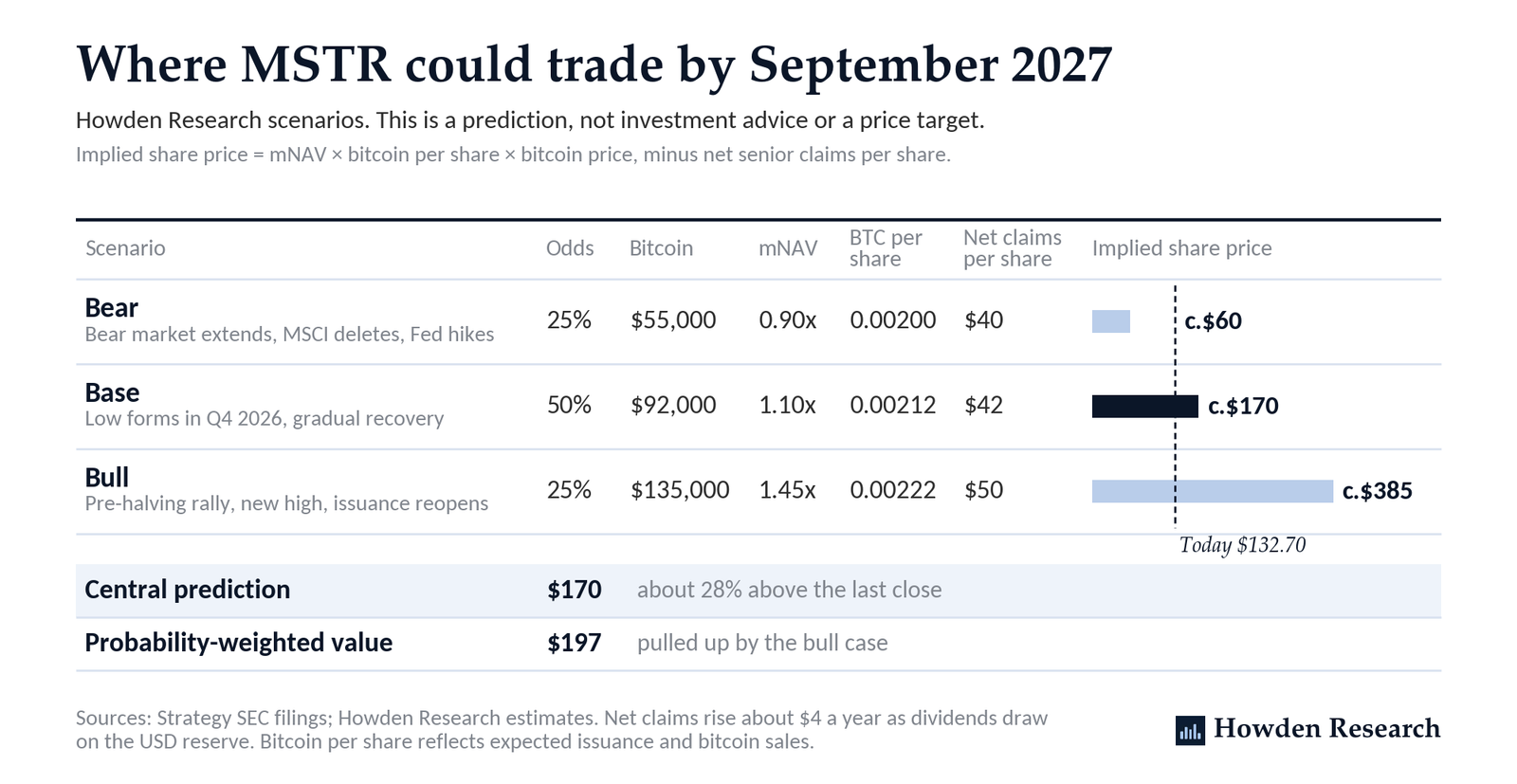
The probability-weighted value is about $197. My central prediction is $170, around 28% above the last close. That's below the Street’s average target of roughly $229 and Canaccord’s $179. Most of the gap is the bitcoin assumption; Siebert’s $350 target assumes $175,000 bitcoin. The base case, each $10,000 on bitcoin moves MSTR by roughly $23.
Two further calls, with the same health warning. Before year-end, I think the path runs through the low $100s, because MSCI, a possible hike and the historical window for bear market lows all fall between now and December. I could easily be wrong on timing, and I'd put S&P 500 inclusion before the end of 2027 at no better than one in three.
The skew is the point. A one in four chance of losing more than half your money sits beside a one in four chance of nearly tripling it. That's a bitcoin call option with a Nasdaq ticker, priced about fairly at 1.05x. Khan Conviction’s Positive reading and my central case agree on direction. Neither changes the answer for a mandate with ESG or Sharia constraints.
The Bottom Line
Strategy spent the summer proving it can survive a bear market by selling a sliver of its bitcoin rather than a slab. It hasn’t proved anyone applying an ESG or Sharia screen honestly should own it, and most coverage never asks. MSCI will ask on 16 October.
Watch the STRC price and the MSCI decision. Everything else follows.
This article is for information purposes only and does not constitute investment advice. The price prediction is an estimate based on state assumptions and may prove to be wrong. Data as at 9 to 10 September 2026
References
- 1. Strategy Inc, "Strategy Announces Second Quarter 2026 Financial Results," 30 July 2026. https://www.strategy.com/press/strategy-announces-second-quarter-2026-financial-results_07-30-2026
- Strategy Inc, Form 10-Q for the quarter ended 30 June 2026, SEC EDGAR. https://www.sec.gov/Archives/edgar/data/0001050446/000105044626000044/mstr-20260630.htm
- Strategy Inc, Form 10-Q (PDF with share count cover page), August 2026. https://assets.contentstack.io/v3/assets/bltf8d808d9b8cebd37/blta5f6928fe67893a6/6a710f63b59102140eee930d/form-10-q_08-03-2026.pdf
- Strategy Inc, "Digital Credit Capital Framework, USD Reserve Policy, STRC Dividend Policy," 29 June 2026. https://www.strategy.com/press/strategy-announces-digital-credit-capital-framework_06-29-2026
- Business Wire, Strategy Q2 2026 results release, 30 July 2026. https://www.businesswire.com/news/home/20260730035038/en/
- The Block, "Strategy repurchases $176 million of STRC shares, makes no bitcoin purchases or sales," 8 September 2026. https://www.theblock.co/news/business/2026-09-08-strategy-bitcoin-strc-repurchase-program-413678
- CoinDesk, "Strategy sold another $105 million of bitcoin last week," 3 August 2026. https://www.coindesk.com/markets/2026/08/03/strategy-sold-another-usd105-million-of-bitcoin-last-week-repurchased-usd81-2-million-of-strc
- CoinDesk, "Strategy raises $2 billion through MSTR sales and creates new USD Cash pool," 24 August 2026. https://www.coindesk.com/markets/2026/08/24/strategy-raises-usd2-billion-through-mstr-sales-and-creates-new-usd-cash-pool
- CryptoSlate, "Michael Saylor gives Strategy until September to repair its dividend engine," July 2026. https://cryptoslate.com/after-an-8-2b-loss-forced-bitcoin-sales-michael-saylor-gives-strategy-until-september-to-repair-its-broken-dividend-engine/
- 24/7 Wall St, "Strategy put $176.3 million into its own preferred stock," 9 September 2026. https://247wallst.com/investing/cryptocurrency/2026/09/09/strategy-put-176-3-million-into-its-own-preferred-stock-instead-of-bitcoin-with-its-last-btc-purchase-already-underwater/
- SEC Form 4, Phong Le, 22 June 2026. https://www.sec.gov/Archives/edgar/data/0001050446/000165166926000010/ownership.xml
- mNAV.com, Strategy (MSTR) mNAV tracker, accessed 9 September 2026. https://www.mnav.com/mnav/strategy
- Investing.com, "Strategy Trades Near Bitcoin Value as mNAV Premium Falls to 1.16," 31 March 2026. https://www.investing.com/analysis/strategy-trades-near-bitcoin-value-as-mnav-premium-falls-to-116-200677619
- Crypto Briefing, "Strategy remains ineligible for S&P 500 rebalance due to GAAP losses," September 2026. https://cryptobriefing.com/strategy-ineligible-sp500-rebalance-gaap-losses/
- Cambridge Centre for Alternative Finance, "Cambridge Digital Mining Industry Report: Global Operations, Sentiment, and Energy Use," April 2025. https://www.jbs.cam.ac.uk/wp-content/uploads/2025/04/2025-04-cambridge-digital-mining-industry-report.pdf
- Crypto Carbon Ratings Institute, "Accounting for carbon emissions caused by cryptocurrency and token systems" (hybrid allocation). https://arxiv.org/pdf/2111.06477
- US EPA, "Greenhouse Gas Emissions from a Typical Passenger Vehicle." https://www.epa.gov/greenvehicles/greenhouse-gas-emissions-typical-passenger-vehicle
- International Energy Agency, "Energy and AI," Executive Summary, April 2025. https://www.iea.org/reports/energy-and-ai/executive-summary
- Blockspace, "Bitcoin hashrate falls 6.3% as mining capital shifts toward AI," July 2026. https://blockspace.media/insight/bitcoin-hashrate-falls-mining-shifts-ai-2026/
- Bloomingbit / BitPlanet Research Lab, "The Economics of Mining in 2026 Reshaped by Record-Low Hashprice," 2 September 2026. https://en.bloomingbit.io/feed/news/119586
- Paul Hastings, "MiCA Crypto White Papers: Comply or Be De-Listed." https://www.paulhastings.com/insights/client-alerts/mica-crypto-white-papers-comply-or-be-de-listed
- Crypto Times, "MSCI Proposal Would Cut Strategy and Metaplanet From Global Indexes," 14 August 2026. https://www.cryptotimes.io/2026/08/14/msci-proposal-would-cut-strategy-and-metaplanet-from-global-indexes/
- TFTC, "MSCI's New Screen Could Strip Strategy and Metaplanet From Global Indexes," August 2026. https://www.tftc.io/msci-non-operating-company-screen-strategy-metaplanet-index-exclusion
- Strategy Inc, response letter to MSCI consultation, 31 August 2026. https://assets.contentstack.io/v3/assets/bltf8d808d9b8cebd37/blt0bd55e19ee9f779f/6a95b24a3481c27fa68ae18f/strategy-msci-second-consultation-response-letter_08-31-2026.pdf
- CoinDesk, "Strategy says MSCI should measure markets, not dictate corporate assets," 14 August 2026. https://www.coindesk.com/markets/2026/08/14/strategy-says-msci-should-measure-markets-not-dictate-corporate-assets
- AAOIFI (Dr Hamed Merah), "Shari'ah Screening Methodology." https://www.oicexchanges.org/files/1---shari-ah-screening-in-the-islamic-capital-markets-dr-hamed-merah-secretary-general-aaoifi.pdf
- Yahoo Finance, "FOMC September 2026 Odds for a Rate Hike Surpass 50%," September 2026. https://finance.yahoo.com/economy/policy/articles/fomc-september-2026-odds-rate-201618784.html
- YieldFund, "Are we in a bear market in crypto? What the data says in 2026." https://www.yieldfund.com/news/are-we-in-a-bear-market-in-crypto-what-the-data-says-in-2026
- crypto.news, "Bitcoin price holds near $79K as cycle drawdowns narrow," 9 September 2026. https://crypto.news/bitcoin-price-holds-near-79k-as-cycle-drawdowns-narrow/
- TS2, "MSTR stock jumps 14% as mNAV reaches 1.05x" (Investing.com consensus), 19 August 2026. https://ts2.tech/en/mstr-stock-jumps-14-twice-bitcoins-gain-as-mnav-reaches-1-05x/
- CoinCentral, "Strategy (MSTR) Stock Falls 4% as Bitcoin Drops Below $80,000," 9 September 2026. https://coincentral.com/strategy-mstr-stock-falls-4-as-bitcoin-drops-below-80000
- Crypto Times, "Strategy (MSTR) Stock's Price Target Debate Comes Down to Bitcoin; Analyst Sees $350," 8 September 2026. https://cryptotimes.io/2026/09/08/strategy-mstr-stocks-price-target-debate-comes-down-to-bitcoin-analyst-sees-350
- Khan Terminal, MSTR Khan Conviction, Valuation, and ESG & Sharia modules, accessed 10 September 2026. https://khanterminal.com