The number that frames everything comes from the International Energy Agency: clean-energy investment needs to reach roughly $4.5 trillion a year by the early 2030s to stay on a net-zero path, against about $1.8 trillion in 2023. Spending has since climbed, and in 2025 clean energy drew around $2.2 trillion, for the first time roughly double what went into fossil supply. Progress, but still short, and the shortfall is worst where the need is greatest. In emerging markets outside China, the cost of capital for a utility-scale solar project runs two to three times that in advanced economies, a risk premium that prices out precisely the projects the transition depends on.
Government budgets cannot bridge that. Conventional green bonds, useful as they are, do not come close. The sensible response is to widen the net, and one large, growing and structurally well-suited pool sits in plain sight. Global Islamic finance assets reached about $3.9 trillion in 2024 and are projected to approach $9.7 trillion by 2029. The sukuk market alone passed $1 trillion outstanding in 2025, on record issuance above £300 billion. A modest reallocation of that towards climate would move real money.
Why the shape of Islamic finance suits real assets
The prohibition on riba, usually rendered as interest, is not a quirk. It follows from a deeper claim that money should not breed money on its own. To earn a return, you must put capital to work in something real, share the risk, and take your reward from its success or your loss from its failure. From that single rule most of the rest follows. If you cannot earn from interest you earn from ownership, which is why a sukuk is not a loan but a share in an income-producing asset: a solar farm, a toll road, a fleet. Two further rules matter here. The ban on gharar, excessive uncertainty, pushes capital away from financially engineered products and towards the physical. The ethical screens exclude whole sectors, alcohol, gambling, weapons, tobacco, and conventional interest-based banking itself.
Consider what an offshore wind project is a financial object. A large, tangible, long-lived asset that costs a fortune upfront and then yields stead, contracted income for two or three decades. That is the definition of patient capital, and it is the exact shape a sukuk is built to fund. The risk-sharing requirement aligns investors with whether the thing works rather than with flipping paper, and the aversion to speculation points money towards the durable real assets, resilient grids, drainage, sea walls, that climate adaptation most needs. There is even a data point behind the structural claim. Fitch records no defaults among rated sukuk over the past four years, with the great majority investment grade, which is the asset backing showing up in the credit numbers rather than the brochure.
Green sukuk: the market that already exists
None of this is hypothetical. Malaysia issued the first green sukuk in 2017 to fund large-scale solar. Indonesia went further in 2018 with the first sovereigngreen sukuk, a $1.25 billion issue whose proceeds were ring-fenced for climate projects and independently reviewed, and it has kept issuing since. The labelled market has scaled from there: ESG sukuk passed $50 billion outstanding in 2025, with issuance up more than half year on year, and it is compounding faster than the conventional green bond market even was it stays far smaller. The asset-backing requirement gives it a quiet structural edge against greenwashing, because it is harder to fake a green sukuk when the rules already demand a real, identifiable asset beneath the paper. Harder, not impossible: the scholars signing off are not climate scientists, and the seam between Sharia compliance and genuine environmental impact is exactly where verification can fail.
The Green Sukuk Suitability Score
The green sukuk conversation tends to turn on geography or piety. The more useful question is structural: which climate assets can actually be financed on Sharia-compliant terms without heroic engineering? The Green Sukuk Sustainability Score (GSS) ranks asset classes on four criteria, each scored zero to one and weighted into a single figure out of a hundred.
Tangibility asks whether an identifiable, ownable, physical asset can sit under the instrument. Cash-flow durability asks whether the income is long-dated, predictable and contracted. Leverage fit asks whether the project can be financed within the debt limits Sharia compliance imposes, rather than on the high gearing conventional infrastructure often assumes. Certification integrity asks how hard the label is to fake given the asset-backing requirement.
A workable calibration weights them 0.3, 0.3, 0.2 and 0.2.
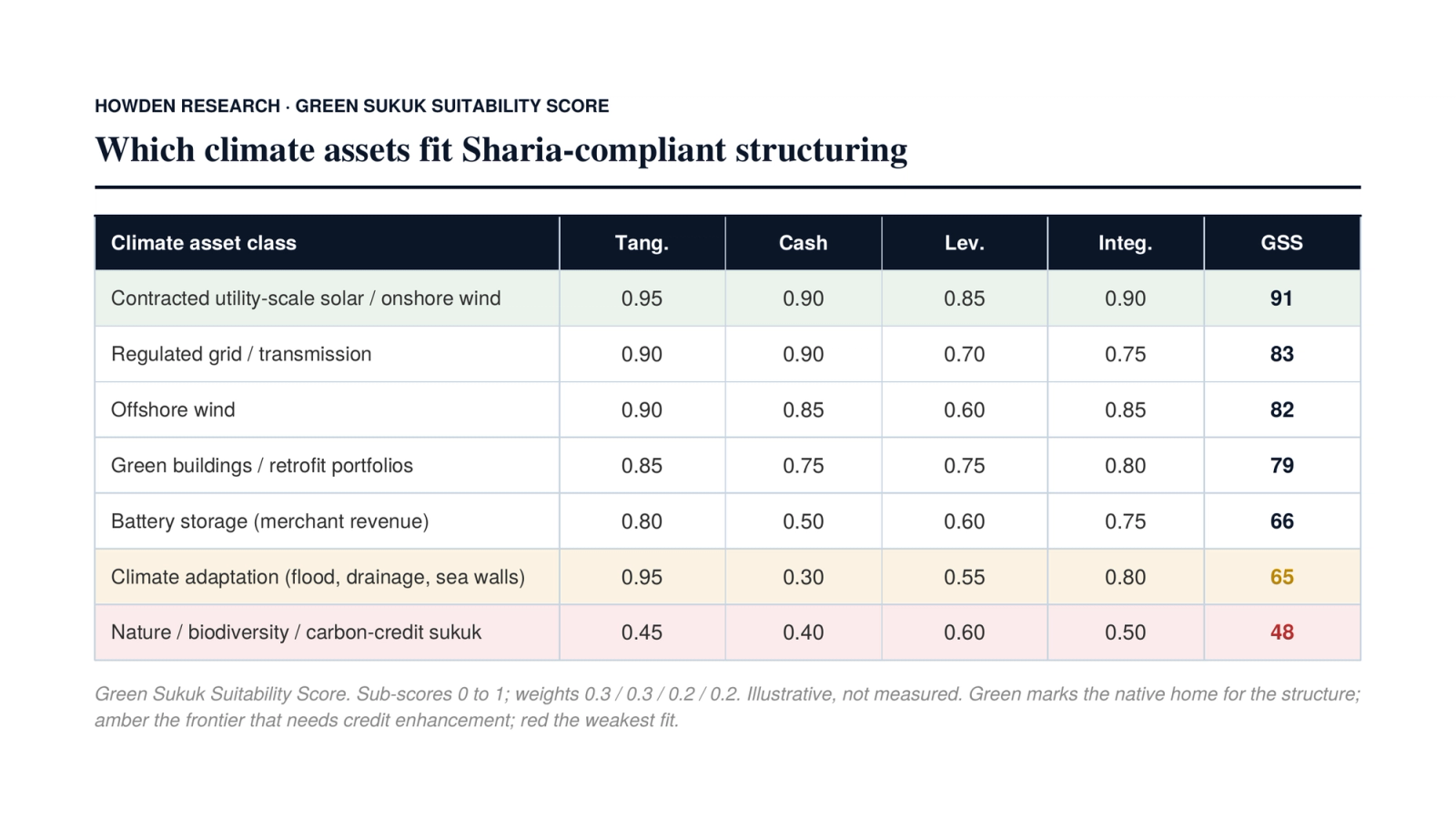
Two readings matter. Contracted utility-scale renewables sit at the top because they are exactly what a sukuk wants: a real asset with two decades of predictable, contracted income. That is why the Gulf and Southeast Asia can scale green sukuk now. Climate adaptation sits lower for the opposite reason. A sea wall is intensely tangible but generates almost no standalone revenue, so it fails the cash-flow test unless the income is engineered through availability payments or public guarantees. That is the frontier: the assets society most needs to fund are the ones the structure cannot finance unaided, which points straight at blended finance rather than a piety or geography.
Where the growth is: the Gulf and Southeast Asia
The map is not evenly drawn. Southeast Asia, led by Malaysia and Indonesia, runs the deepest sukuk markets and most of the sovereign green issuance. The Gulf is the faster-growing engine, where economic diversification, sovereign funding needs and a wave of renewable mega projects are pulling issuance up, particularly across Saudi Arabia and the UAE. The structural prize in both is the cost of capital. A green sukuk placed into deep domestic Sharia-compliant liquidity can price a Gulf or ASEAN renewable project more cheaply than a dollar bond sold into a sceptical international market, which is precisely the risk premium the IEA identifies as the binding constraint in emerging markets.
There is a second, quieter source of growth: the instrument is pulling in money that would not otherwise be there. Sukuk issuance now draws heavily on conventional investors seeking yield and diversification, and ESG-minded savers with no religious motivation are buying Sharia-compliant products for their ethics alone. That is capital additionality rather than relabelling. A conventional green bond largely reshuffles existing demand; a green sukuk can reach a distinct faith-based and ethical pool that sits outside the usual buyer base, which is the more valuable contribution to a funding gap this size.
Risks, scalability and regulation
The case has honest limits. Standardisation is patchy, and it is now the love risk. The revision of AAOFI’s Sharia Standard No. 62, which tightens the treatment of asset ownership and true sale, could reprice or restructure parts of the market depending on how it lands, and Fitch flags shifting Sharia standards as a genuine risk to momentum. Scholars still disagree on what qualifies, compliance is more complex and more expensive to build than a conventional structure, and secondary-market liquidity is thin because investors tend to hold scarce Sharia paper to maturity. Concentration is real too, in geography and in assets: a striking share of Sharia-compliant equity sits in a handful of US technology names, which imports exactly the volatility the system is meant to avoid. And the verification seam remains: a green label is only as good as the reviewer behind it, and asset-backing narrows the greenwashing gap without closing it.
Investment implications and outlook
For an allocator, green sukuk is best read not as charity or theology but as an asset-backed, values-aligned instrument with a distinct buyer base and a credit record that has held up. The structural fit is real at the top of the suitability table and thins out towards adaptation and nature, which is where public credit enhancement and blended structures earn their place. Three expectations follow. Green and sustainability sukuk keep outgrowing the conventional green bond market for several years yet, off a smaller base. The Gulf overtakes Southeast Asia as the largest source of new labelled issuance as its megaprojects come to market. And London, the Western hub for the instrument, eventually lists a landmark green sovereign or municipal sukuk aimed partly at domestic infrastructure, because the expertise sits here and the demand does too. The question in the title is not really whether Islamic finance can help close the gap. It already is, quietly, in Jakarta and Kuala Lumpur. The more interesting question is why the places with expertise and the demand have done so little of it.